





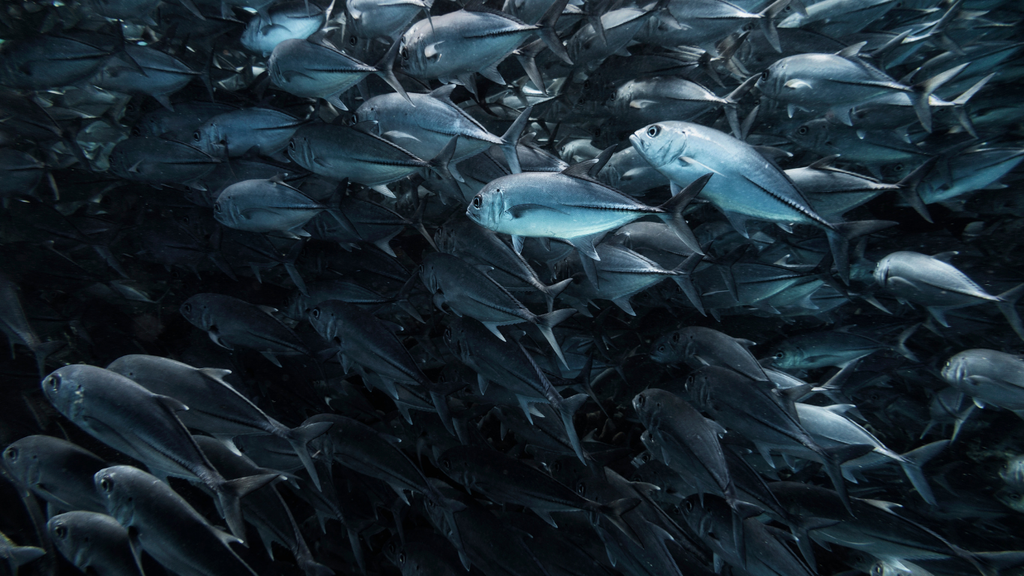
Fish behaviour can change before a diver has even noticed that the water is moving.
A school that appeared scattered begins to face one direction. Small reef fish rise higher above the coral. Barracuda tighten their formation. Other fish disappear behind a ridge, choosing a quieter pocket of water while the exposed side of the reef becomes busier.
To us, current can feel like a condition we need to manage during a dive. For marine life, moving water is part of the environment they read constantly. It can carry food, change the effort required to hold position and influence where an animal chooses to feed, rest or wait.
Once divers begin noticing these responses, a reef stops looking like a collection of animals and starts feeling like a living system.
Current is not simply water pushing in one direction. Its speed and direction can change with tides, weather, depth and the shape of the reef. A wall, channel, ridge or coral head can redirect the flow, creating fast-moving areas beside sheltered pockets.
Fish behavior respond to that changing environment. Their position may reveal where food is arriving, where swimming requires less energy or where the reef offers protection. Two parts of the same dive site can therefore look completely different at the same moment.
This does not mean that current controls every movement a fish makes. Light, temperature, predators, reproduction, habitat and the presence of other animals also influence behaviour. Current is one part of a much larger conversation.
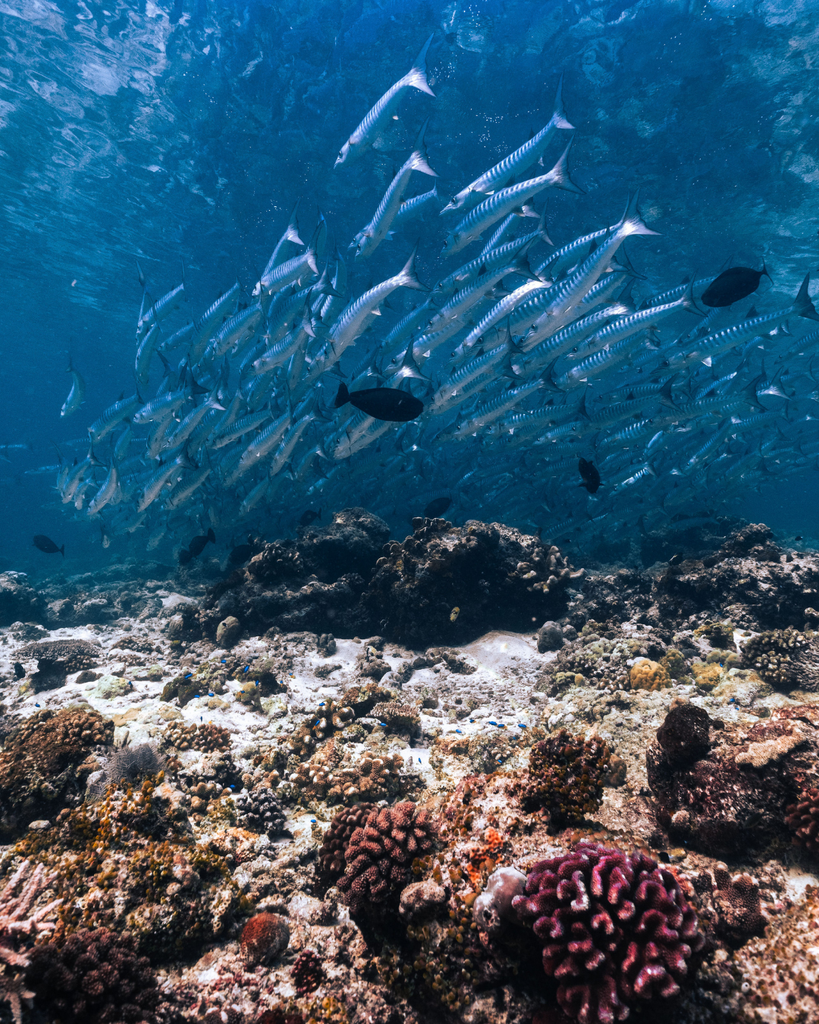
One of the easiest patterns for divers to notice is a group of fish facing the same direction. They are often facing into the flow.
For species that feed on drifting plankton, this position allows food to arrive from in front of them. Instead of chasing every small item through open water, the fish can hold near a productive part of the reef and intercept what the current delivers.
Facing the flow can also help a fish maintain a stable position and respond to changes in the water. The exact reason depends on the species, the location and what the fish is doing. A neat line of fish does not always mean feeding, but it is a useful clue.
Look closely at smaller reef fish above a coral head. They may rise into the moving water to feed, then retreat towards the reef when conditions change or a possible threat approaches.
Current transports tiny organisms and suspended material across the reef. This creates feeding opportunities for planktivorous fish, corals and other animals that depend on food moving through the water column.
Research on reef planktivores shows that feeding behaviour is influenced by both prey density and flow. Faster water does not always mean a fish can capture more food. At some point, holding position and turning towards individual prey can become more difficult. Different species solve this problem in different ways.
Garden eels offer a wonderfully visible example. In gentler flow they may extend farther from their burrows. As current increases, they can shorten and curve their bodies to reduce drag while continuing to feed on drifting zooplankton.
On a reef, the richest feeding position is therefore not necessarily the place with the fastest water. It may be an edge where food passes within reach, a point where flow is redirected or a sheltered spot beside a more energetic area.
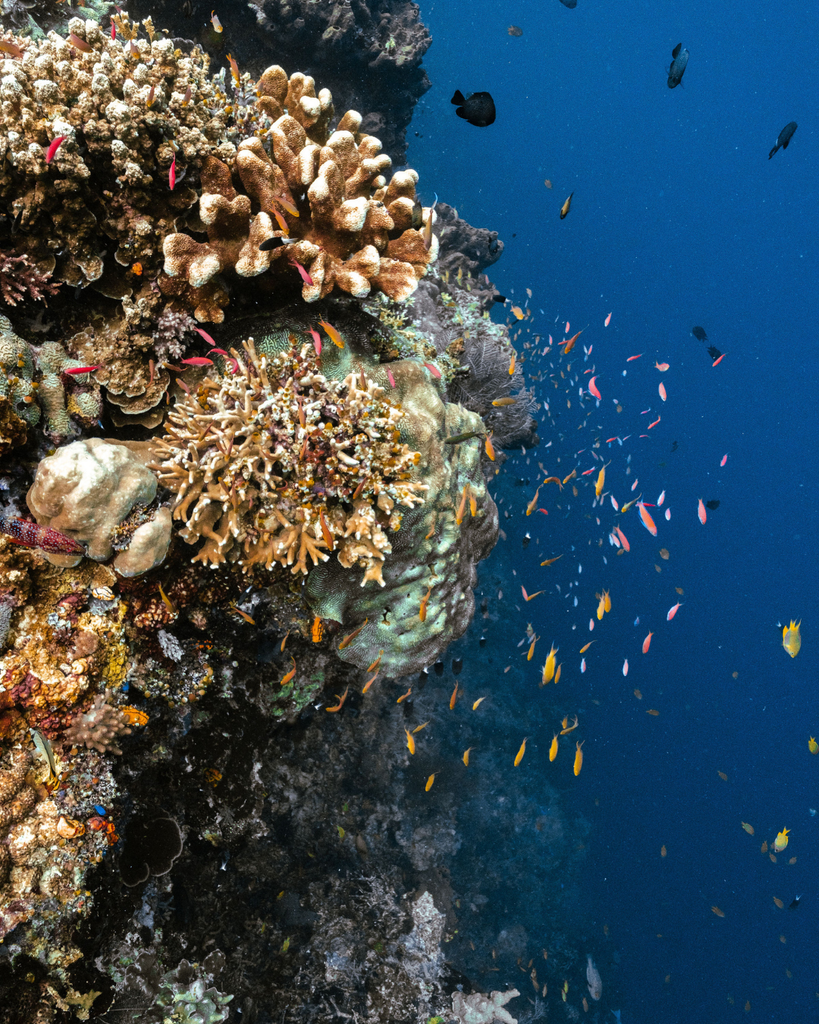
A school of jackfish or barracuda can look like a single enormous animal. Hundreds of individuals turn, compress and expand with astonishing coordination.
Schooling has several possible benefits. It can make it harder for a predator to isolate one individual, help fish respond rapidly to threats and allow information to travel through the group. Research also suggests that fish can sometimes gain hydrodynamic benefits by adjusting their movements in relation to nearby fish.
That does not mean every formation is a deliberate energy-saving pattern. Fish within a school are constantly responding to neighbours, food, threats and the surrounding water. The impressive shape we see may be the result of many small decisions happening almost simultaneously.
Current adds another influence. A school may align into the flow, become more compact or shift to a different part of the reef. When the water changes, the architecture of the school can change with it.
Coral reefs interrupt moving water. As current passes around a ridge, through a channel or over a coral head, it creates areas with different flow conditions.
Some fish move towards the exposed side where more food may be arriving. Others use the protected side of a structure to rest or reduce the effort needed to hold position. Divers do something similar when a guide leads a group behind a coral formation to pause in calmer water.
These quieter areas are sometimes called eddies or current shadows, although the flow around a real reef is complex and constantly changing. For a diver, the practical lesson is simple: water movement is rarely identical across an entire site.
Watching where fish gather can provide useful information, but it should never replace following the guide or checking the conditions directly.
Where prey gathers, predators may follow.
Jacks, barracuda and reef sharks do not appear simply because there is current, and no encounter can be guaranteed. However, moving water can help create productive areas where smaller fish feed or concentrate. Predators may patrol those edges, use the shape of the reef or position themselves near potential feeding opportunities.
This is one reason an active part of a reef can feel layered. Small fish face into the flow above the coral, a dense school forms farther into the blue and larger animals move around the outside. Every level is responding to both the water and the animals around it.
For divers, the most interesting action is not always directly in front of the reef. It is worth looking towards the edge of the school and occasionally into open water.
Divers sometimes return to a familiar site and wonder where all the fish have gone. On another day, the same reef seems almost overloaded with life.
The animals may still be nearby, but their position and behaviour can change with the flow. A school may move to another side of the reef. Planktivores may remain closer to shelter. Predators may patrol a different edge. During a change of tide, the whole scene can reorganise.
This is particularly noticeable around an archipelago shaped by channels, islands and tides. In the Derawan Archipelago, local knowledge helps guides understand how different sites tend to respond to changing water movement. Conditions are assessed on the day because an underwater landscape is never truly static.
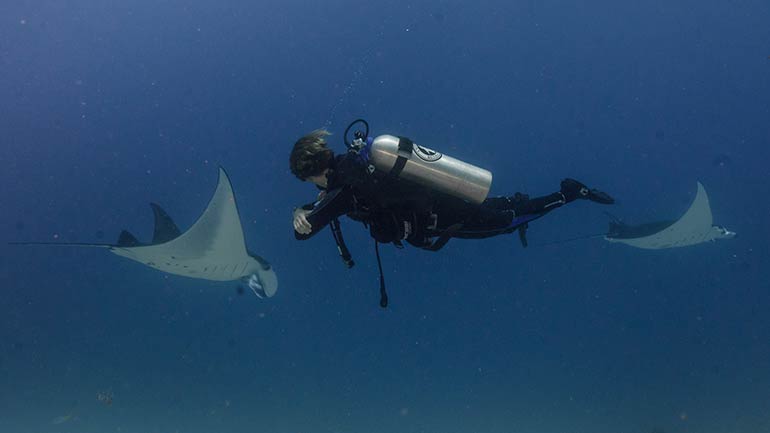
You do not need to identify every species to become a better observer of fish behavior.
Begin by looking at direction. Are most fish facing the same way? Notice position. Are small fish high above the reef or staying close to shelter? Look at the shape of a school. Is it loose, tightly packed, turning or holding steadily in one area?
Then watch for changes. A sudden compression may signal that the school is responding to a possible threat. Fish retreating towards coral may indicate a change in water movement or the approach of a larger animal. A group rising into the current may be feeding.
These observations are clues, not absolute rules. The pleasure comes from slowing down, forming a question and continuing to watch.
A wildlife checklist tells us which animals were present. Behaviour tells us what was happening.
The barracuda were not only there. They formed a wall, then turned into a spiral. The batfish were not simply swimming past. They were holding together in the flow. The small reef fish were not background colour. They were feeding in moving water and retreating to shelter in perfect coordination.
Learning to notice these moments can transform even a familiar species into the highlight of a dive.
Many fish face into the flow to hold position or intercept food carried by the water. The reason varies between species and situations, so direction should be treated as a clue rather than a universal rule.
No. Current can increase feeding opportunities, but very fast water may make feeding or holding position difficult for some species. Fish may also move to a different part of the reef.
A school may respond to current, nearby predators, food or the movement of neighbouring fish. Small individual reactions can spread quickly through the group.
Fish alignment can offer a clue, especially when many are facing the same direction. Divers should still rely on direct observation, their guide and appropriate dive procedures.
No. Habitat, food, temperature, tides, reproduction, cleaning activity and predator-prey relationships can all influence where animals gather.
Current is invisible until it moves something. A diver may notice it through bubbles, a waving sea fan or the effort needed to swim. Fish reveal it through behaviour.
Watch which direction they face, where they choose to wait and how a school changes shape. The longer you observe, the more the reef begins to explain what the water is doing.
That is when a dive becomes more than a list of sightings. It becomes a story unfolding in real time.
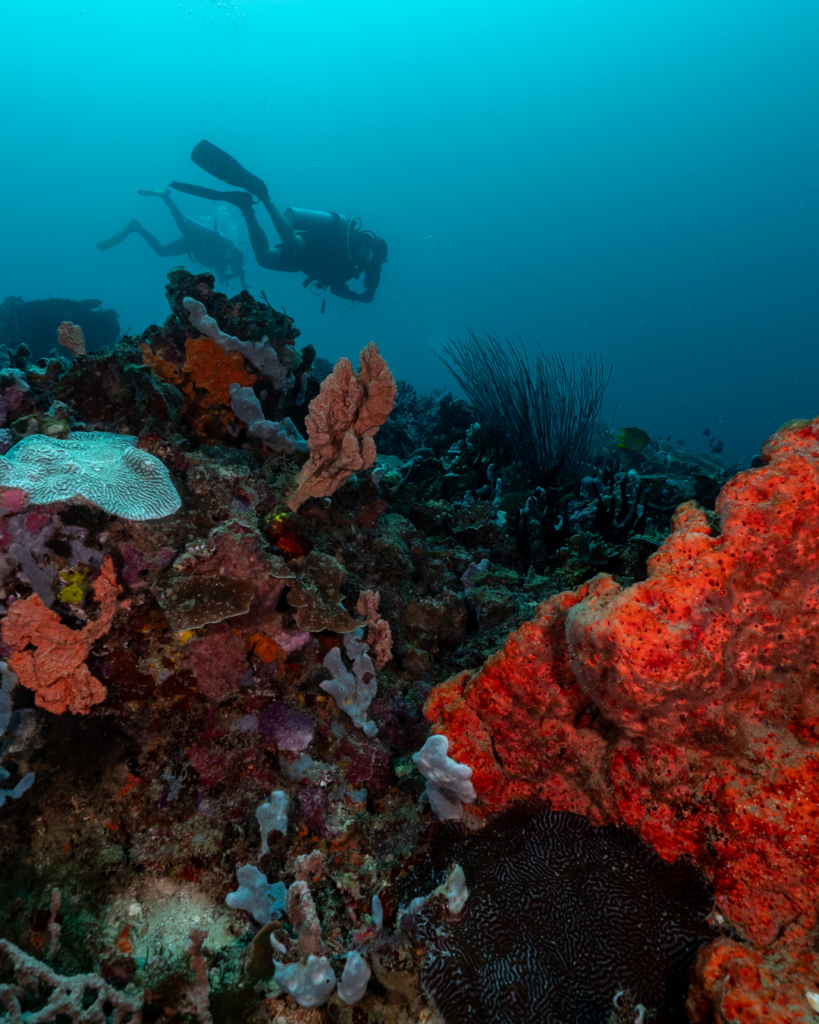
The first time you descend onto a healthy coral reef, it almost feels unreal.
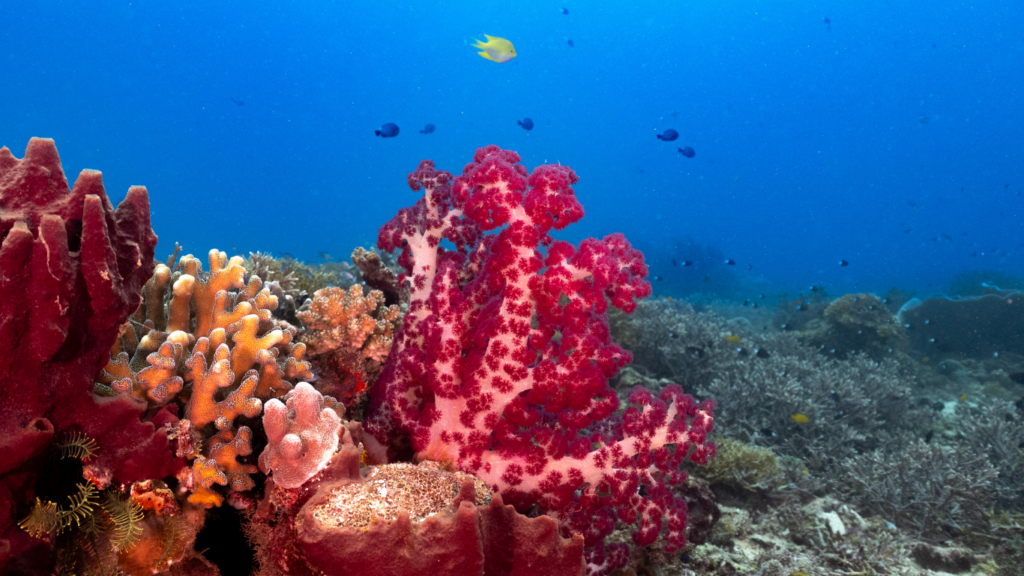
Bright yellow butterflyfish weave through purple soft corals. Electric blue damselfish dart between orange sponges. Pink anemones sway gently while clownfish disappear into their tentacles. Everywhere you look, the reef seems to burst with colour.
It is easy to believe that nature simply enjoys painting the underwater world.
But nothing in the ocean happens by accident.
Every colour you see beneath the surface has a purpose. Some help animals hide, others help them communicate, and many are the result of extraordinary partnerships that have been evolving for millions of years.
Once you understand the story behind coral reef colours, you stop seeing the reef as a beautiful landscape.
You begin to see it as a living conversation.
One of the biggest surprises for many divers is discovering that corals are animals.
Although they often look like colourful rocks or underwater plants, corals are actually tiny animals called polyps. Thousands of these tiny creatures live together, building the reefs that support some of the richest ecosystems on Earth.
So where do all those colours come from?
Part of the answer lies in a remarkable partnership.
Inside the tissues of most reef-building corals live microscopic algae called zooxanthellae. These algae use sunlight to produce energy through photosynthesis, sharing much of that energy with the coral. In return, the coral provides the algae with shelter and the nutrients they need to survive.
It is one of nature’s most successful examples of symbiosis.
The algae also give many corals their golden, brown and green tones, while the corals themselves produce colourful pigments that help protect them from intense sunlight. Together, these two partners create the incredible palette we associate with tropical reefs.
If corals create the stage, reef fish are the performers.
Walk through a city and people communicate with words, expressions and gestures.
On a reef, colour is part of the language.
Some fish use bright colours to attract a mate. Others use bold patterns to warn rivals that a territory is already occupied. Juvenile fish often display different colours from adults, signalling that they are not yet competitors.
Camouflage is just as important.
A fish covered in spots, stripes or patches may look obvious to us, but against a reef full of corals, sponges and shadows, those patterns help it disappear surprisingly well.
Even predators rely on colour. A leopard shark resting on the sandy seabed blends so perfectly with its surroundings that divers can swim straight past without noticing it.
The reef is colourful because every animal has found its own way of surviving.
Have you ever noticed that underwater photos often look bluer than what you remember seeing?
Or perhaps you’ve looked at a bright red object while diving and wondered why it suddenly appeared brown or grey.
The answer has nothing to do with the coral or the fish.
Sunlight is made up of different colours, each with a different wavelength. As light travels through water, those colours are absorbed one by one.
Red is the first to disappear, often within the first few metres. Orange follows, then yellow. As you dive deeper, green begins to fade as well, leaving mostly blue light reaching greater depths.
That is why the ocean often looks blue from the surface.
It is also why underwater photographers use strobes or video lights. By adding white light back onto the reef, they reveal the true colours that are still there but hidden from our eyes.
The colours have never disappeared.
Only the light has.
A colourful reef is not automatically a healthy reef.
Some brightly coloured corals produce fluorescent pigments when they are under environmental stress. Others naturally display vivid colours even in perfect conditions.
However, healthy tropical reefs usually contain an incredible variety of colours because they support a diverse community of corals, fish, algae, sponges and countless other marine organisms.
Diversity creates colour.
And colour often reflects the complexity of the ecosystem.
This is one of the reasons the reefs of the Derawan Archipelago leave such a lasting impression on divers. From the coral gardens around Sangalaki to the walls of Maratua and the reefs surrounding Kakaban, every site offers a different combination of colours, textures and marine life.
No two dives ever look exactly the same.
Perhaps the most powerful reminder of the importance of coral reef colours is what happens when they disappear.
When water temperatures remain unusually high for extended periods, corals become stressed and may expel the microscopic algae living inside them.
Without these algae, the coral loses much of its colour, revealing the white limestone skeleton beneath. This process is known as coral bleaching.
A bleached coral is not necessarily dead.
If conditions improve quickly enough, the algae can return and the coral may recover.
But prolonged stress can make recovery difficult, affecting not only the coral itself but also the countless species that depend on healthy reefs for food and shelter.
This is why protecting coral reefs matters so much. Healthy reefs support marine biodiversity, protect coastlines and provide livelihoods for millions of people around the world.
Many divers spend their first dives searching for turtles, sharks or manta rays.
There is nothing wrong with that.
But after a while, something changes.
You begin to notice the smaller details.
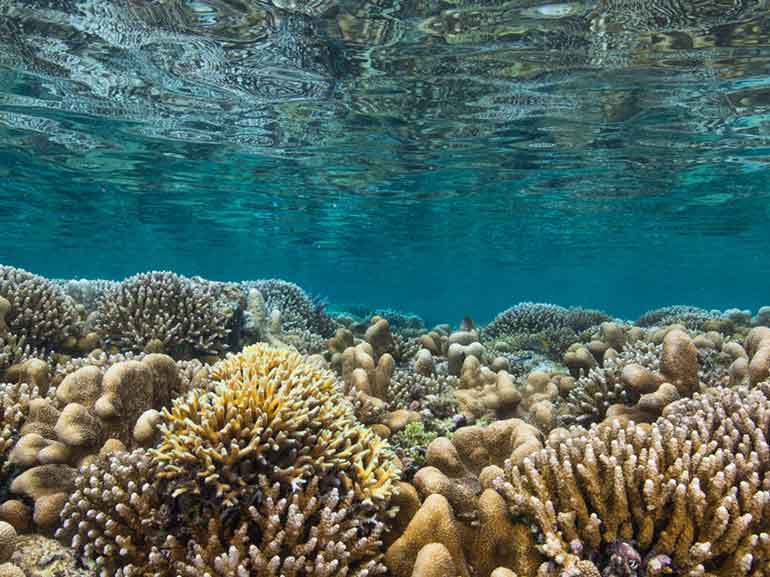
The tiny blue damselfish defending a patch of coral. The fluorescent edge of a giant clam. The way soft corals sway with the current. The unexpected splash of orange on a sponge tucked beneath a ledge.
Suddenly, the reef becomes more than a backdrop for big marine life.
It becomes the attraction itself.
And once that happens, every dive feels richer.
Coral reef colours come from a combination of coral pigments, microscopic algae living inside corals, colourful fish, sponges, algae and many other marine organisms.
Corals are animals. Individual coral polyps build the limestone structures that form coral reefs, while living in partnership with microscopic algae.
Fish use colour for communication, camouflage, attracting mates, defending territory and recognising members of their own species.
Water absorbs different colours of light at different depths. Red disappears first, followed by orange and yellow, leaving mostly blue light at greater depths.
Coral bleaching happens when stressed corals expel the algae living inside them, causing them to lose much of their colour. Bleached corals can recover if conditions improve.
Yes. The reefs around Sangalaki, Kakaban, Maratua and Derawan Island are known for their rich marine biodiversity and vibrant coral ecosystems, making the archipelago one of Indonesia’s most rewarding diving destinations.
The next time you descend onto a reef in the Derawan Archipelago, take a moment before searching for turtles or sharks.
Look at the colours around you.
The yellow butterflyfish disappearing into the coral. The purple soft corals dancing in the current. The giant clam glowing with electric blues and greens.
None of those colours are there by chance.
They are the result of millions of years of evolution, remarkable partnerships and countless strategies for survival.
Once you understand the story behind coral reef colours, you no longer see a beautiful reef.
You see an ecosystem speaking its own language.
And every dive becomes a little more fascinating than the last.
Ask a new diver how they feel about current, and you’ll probably hear the same answer.
“I hope there isn’t too much.”
Ask an experienced diver, and the response is often the opposite.
“I hope there’s some current today.”
At first, that sounds strange. Why would anyone want to swim against moving water? Isn’t calm water supposed to make for an easier, more enjoyable dive?
The answer lies in understanding that the ocean is never really still. Current is not something separate from the reef. It is part of the reef. It carries food, oxygen, nutrients and life itself. Without it, many of the underwater encounters that make the Derawan Archipelago so famous would happen far less often.
The next time you hear a dive guide smile when they mention a little current, you’ll know there is usually a very good reason.
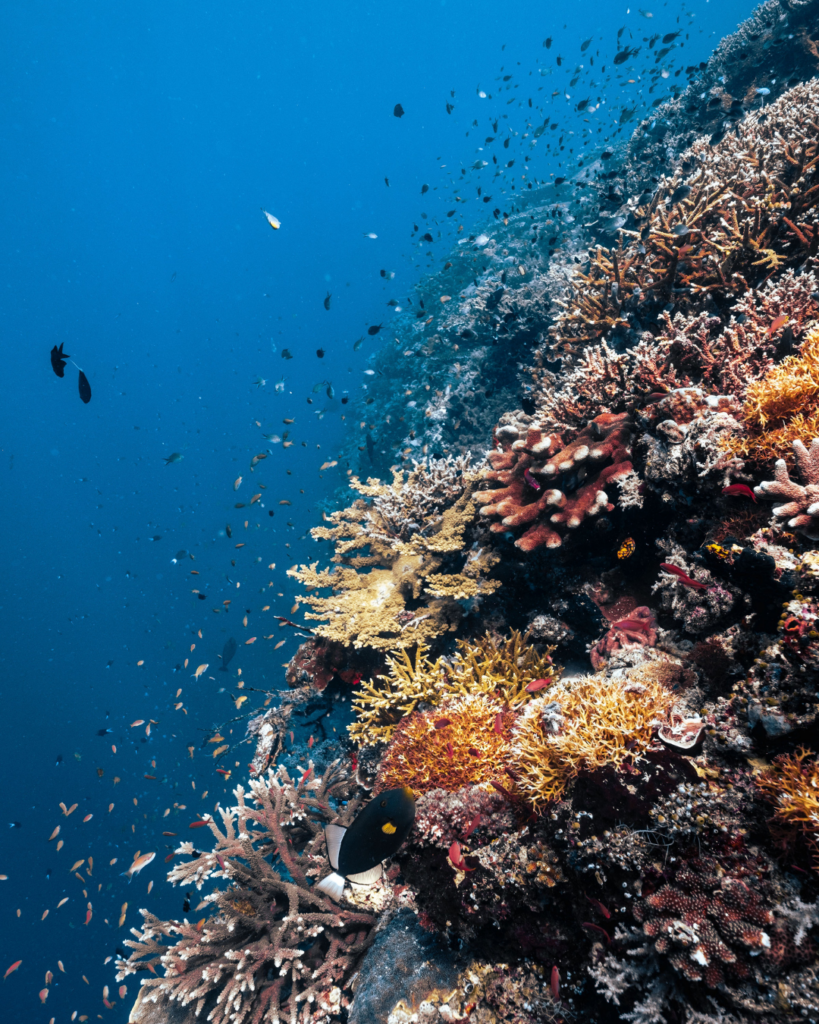
Imagine a forest where nothing ever moved. No wind. No rain. No fresh nutrients arriving from elsewhere.
Eventually, that forest would struggle.
Coral reefs work in a similar way.
Ocean currents transport microscopic plankton, larvae and nutrients across enormous distances. Every time water moves over a reef, it brings food for countless animals, from tiny filter feeders to giant manta rays.
Corals themselves benefit from water movement. Current helps deliver oxygen while carrying away waste products and sediment that could otherwise settle on the reef.
It is one of the reasons healthy reefs are often found where the water is alive with movement.
Marine life has learned to use the ocean almost like we use roads.
Some animals wait where the current is strongest because they know food will come to them instead of the other way around.
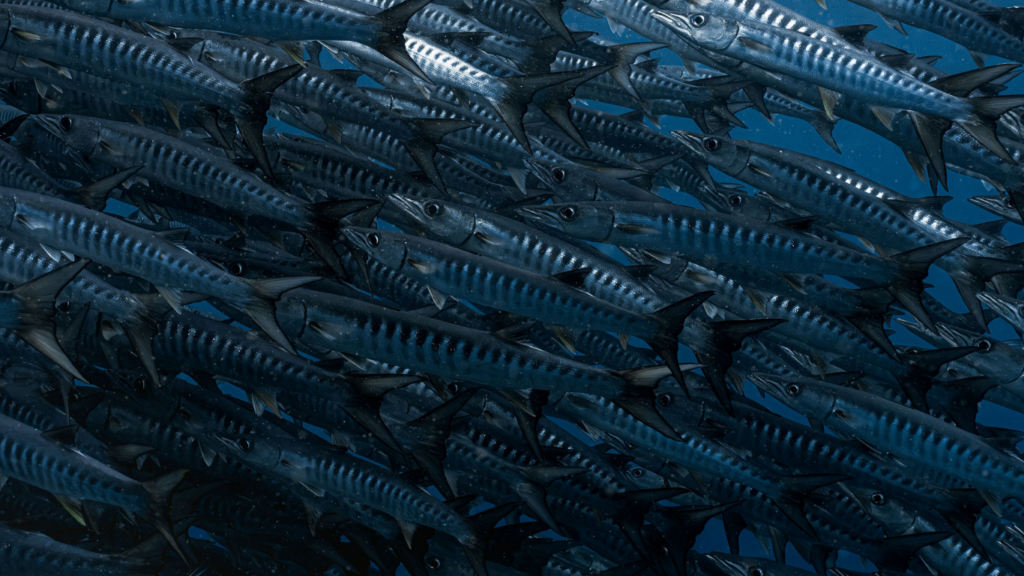
Trevallies patrol the edges of current waiting for an easy meal. Barracudas gather in schools facing into the flow. Reef sharks cruise effortlessly through moving water, using surprisingly little energy while searching for opportunities.
Even manta rays often position themselves where currents concentrate plankton, allowing them to feed more efficiently.
Rather than fighting the ocean, these animals work with it.
It is one of the greatest lessons the sea can teach.
One of the reasons the Derawan Archipelago has earned its reputation among experienced divers is that the islands sit within a dynamic marine environment.
Sites around Sangalaki, Kakaban and Maratua are influenced by tides and currents that change throughout the day. Some dives begin gently before building into stronger movement. Others remain calm from start to finish.
These changing conditions create incredible diversity. A reef that feels quiet in the morning may become full of life a few hours later simply because the tide has changed.
That is why local dive guides pay so much attention to tide tables, moon phases and current predictions. Knowing when to enter the water is often just as important as knowing where.
One of the biggest misconceptions in diving is that current automatically means a difficult or exhausting dive.
In reality, many dives involve drifting gently with the water rather than swimming against it.
Good planning makes all the difference. Experienced guides choose entry points, routes and timings that allow divers to enjoy the movement safely while letting the current do much of the work.
Of course, some sites are more demanding than others, and conditions should always match a diver’s experience level. But current itself is not the enemy. Understanding it is part of becoming a better diver.
Divers often spend their first few dives looking for individual animals.
After enough time underwater, something changes.
You start looking at the water itself.
You notice the way soft corals lean in one direction. You see schools of fish holding their position effortlessly. You watch tiny particles drifting past your mask and realise they are telling you where the ocean is moving.
Eventually, you stop asking, “Where are the fish?”
Instead, you ask, “Where is the current?”
The answer is often the same.
Yes, when dives are planned according to the conditions and your level of experience. Good briefings and experienced guides make all the difference.
Swimming into the current helps sharks detect scents, locate prey and conserve energy while waiting for food to come to them.
Current concentrates plankton, making feeding more efficient for manta rays.
No. Conditions vary between islands, dive sites, tides and weather. Some dives are calm, while others experience stronger water movement.
Not necessarily. Many gentle drift dives are suitable for newer divers, while stronger currents are better left until you have more experience.
They combine tide tables, local knowledge, weather conditions and years of experience diving the same sites.
Current is often misunderstood.
Many divers see moving water as something to overcome, when in reality it is one of the reasons reefs are so vibrant in the first place.
The next time you enter the water in the Derawan Archipelago, take a moment to look beyond the coral and the fish. Watch the tiny particles drifting past, notice the way marine life positions itself, and pay attention to the invisible force connecting everything around you.
Because the ocean is always moving.
And where the water moves, life usually follows.
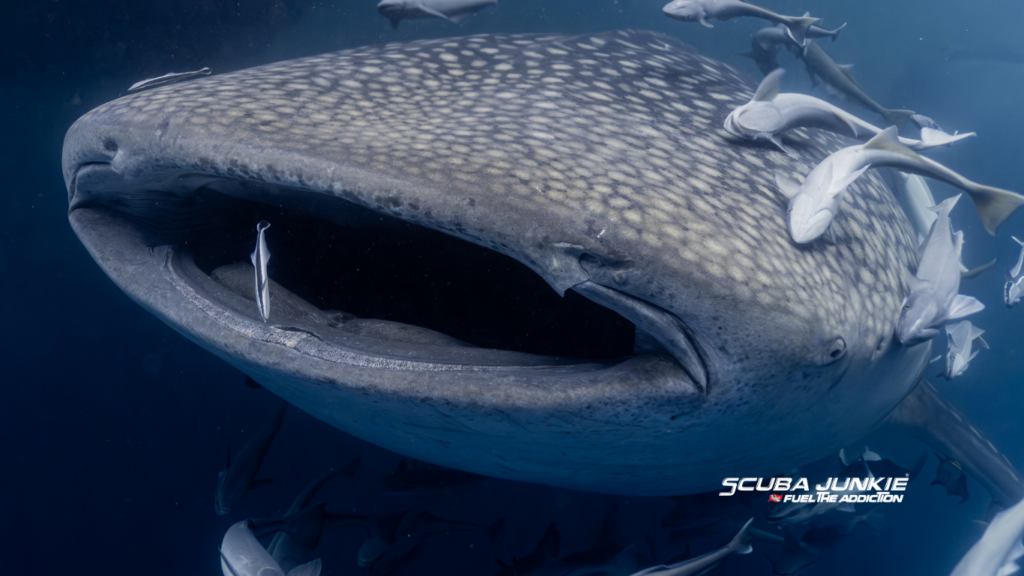
Imagine you are floating in the water, face-to-face with the largest fish on Earth.
A whale shark glides slowly beneath you. Its enormous mouth opens as it filters water, completely uninterested in your presence. Your eyes follow the pattern of white spots along its back, and for a moment, it feels like the only thing in the ocean.
Then you notice something else.
Small fish tucked underneath its belly. A few near its gills. Others attached along its sides. Sometimes they are tiny. Sometimes they are surprisingly large. They seem completely at home, as if they belong there.
And in a way, they do.
The story of whale shark remora symbiosis is one of the most fascinating partnerships in the ocean. It is a relationship built on cooperation, opportunity, and millions of years of evolution. And once you understand it, you will never look at a whale shark the same way again.
To understand the relationship, we first need to meet the remora.
Remoras are a family of fish famous for one unusual feature. On top of their heads sits a modified dorsal fin that has evolved into a suction disc. This natural adaptation allows them to attach themselves to larger animals.
At first glance, it can look like they are stuck to the whale shark. In reality, they can attach and detach whenever they want. Think of it as a living suction cup designed by nature.
For a remora, finding a whale shark is a little like finding a moving house.
It provides transportation, protection, and access to food, all without the remora needing to spend much energy.
Not a bad deal for a fish.
The word “symbiosis” often sounds more complicated than it really is.
In simple terms, symbiosis is a close relationship between two different species.
Some symbiotic relationships benefit only one animal. Others benefit both. Some can even be harmful to one partner.
The whale shark remora symbiosis is generally considered a form of mutualism or commensalism, depending on the situation. Scientists continue to study the relationship, but the important point is that neither animal appears to suffer from it.
Instead, both seem to gain something from the arrangement.
Like many good roommates, they make life easier for one another.
A whale shark spends much of its life moving through the ocean in search of plankton and other tiny food sources.
For a remora, following a whale shark offers several advantages.
The most obvious is transportation.
Rather than swimming long distances on its own, the remora can travel efficiently by attaching itself to the whale shark. This allows it to conserve energy while exploring vast stretches of ocean.
Food is another benefit.
As a whale shark feeds, small scraps and particles drift away. Remoras take advantage of these opportunities, feeding on leftovers that would otherwise be lost.
The whale shark, meanwhile, gains something too.
Remoras are known to consume parasites, dead skin, and unwanted organisms from their hosts. While a whale shark could certainly survive without remoras, having a few diligent cleaners around is unlikely to be a disadvantage.
The result is one of the ocean’s most successful partnerships.
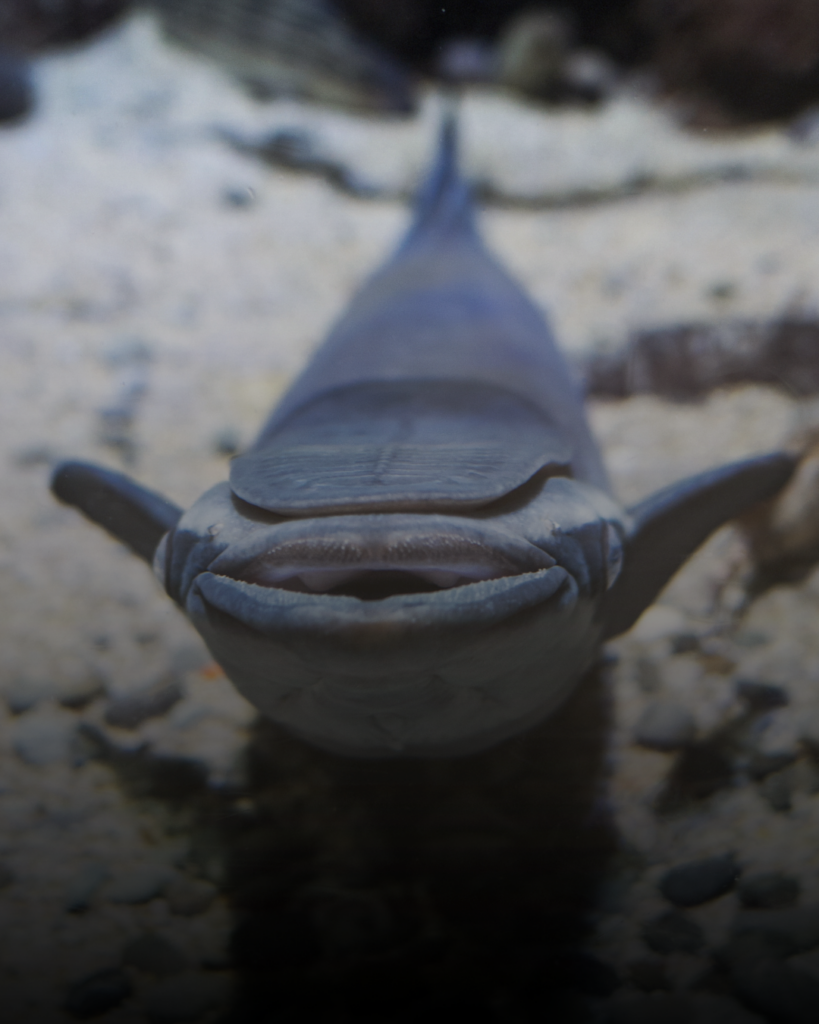
One of the most remarkable aspects of whale shark remora symbiosis is the remora’s ability to stay attached while the whale shark swims.
The suction disc on top of the remora’s head contains a series of movable plates. When pressed against a surface, these plates create a strong grip.
This allows the remora to remain attached even when the whale shark changes direction or increases speed.
Despite this impressive attachment system, remoras are not permanent passengers. They move around frequently, switching positions and sometimes leaving one host to find another.
It is less like being glued to a whale shark and more like choosing the best seat on a very large bus.
Although whale sharks are among the most famous hosts, remoras are not particularly picky.
They can be found attached to:
Some have even been observed attaching themselves to boats.
For a remora, the goal is simple. Find something large, safe, and constantly moving through food-rich waters.
Whale sharks happen to be particularly attractive options.
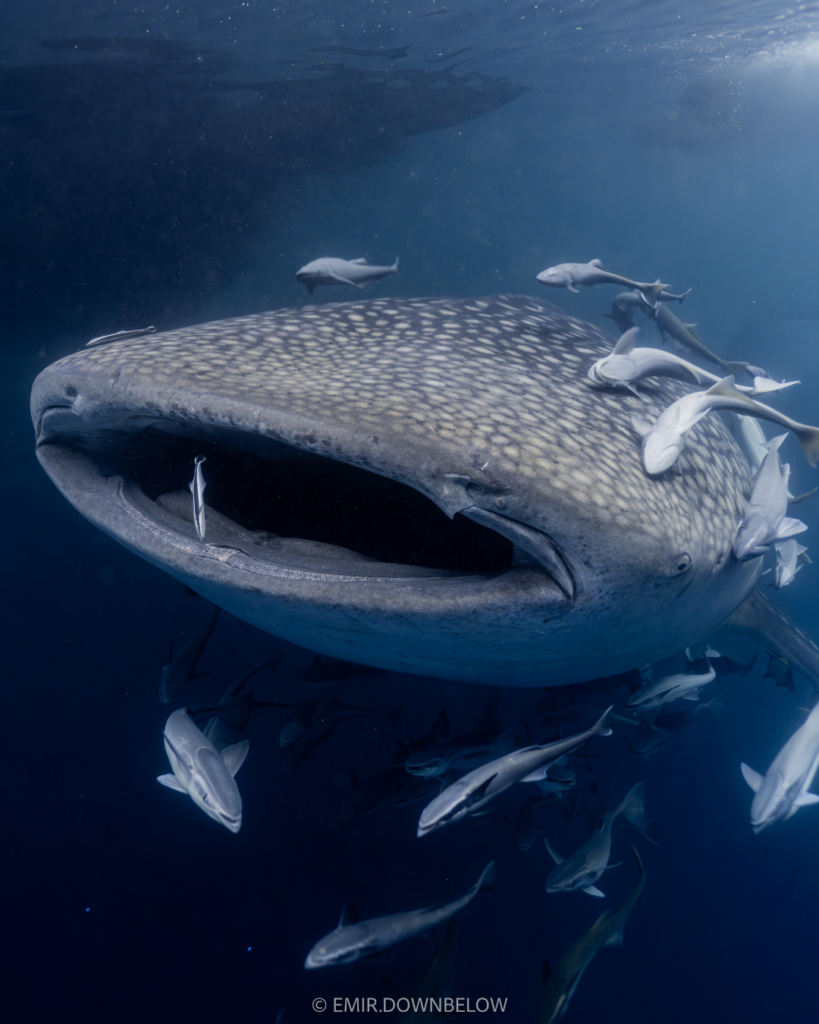
One of the reasons whale shark encounters in the Derawan Archipelago are so memorable is that they allow you to observe more than just the whale shark itself.
Many guests join the whale shark trips hoping to see the giant fish, and understandably so. But those who take a moment to slow down often notice the details.
Look beneath the whale shark. Around its gills. Along its sides.
You may spot several remoras travelling alongside their enormous host.
Suddenly, what seemed like a single animal becomes an entire story unfolding in front of you.
The whale shark is not travelling alone.
The longer divers spend underwater, the more they realise that nothing exists in isolation.
Cleaner wrasse depend on larger fish. Coral depends on algae. Reef predators depend on healthy fish populations.
The whale shark remora symbiosis is another reminder that the ocean is built on connections.
Every animal plays a role.
Even one of the largest creatures on Earth shares its journey with a fish small enough to fit in your hand.
That contrast is part of what makes the relationship so fascinating.
Current observations suggest that remoras do not significantly harm whale sharks. In many cases, they may even help by removing parasites and dead skin.
No. Parasites benefit at the expense of their host. Remoras generally do not cause harm and may provide benefits, making the relationship different from parasitism.
They gain transportation, protection, and access to food while conserving energy.
Yes. Remoras can attach to many different marine animals and can swim freely when needed.
No evidence suggests that whale sharks actively prey on remoras. The two species coexist peacefully.
Absolutely. In fact, noticing the remoras is one of the easiest ways to appreciate the complexity of the encounter beyond simply seeing the whale shark itself.
The next time you find yourself swimming alongside a whale shark, try looking beyond the giant.
Notice the smaller fish travelling beneath it. Watch how effortlessly they move from one position to another. Think about the journey they are sharing.
The whale shark may be the star of the show, but the story of whale shark remora symbiosis reminds us that some of nature’s most fascinating relationships happen quietly in the background.
And once you start noticing them, the ocean becomes a much richer place.
Understanding ocean behavior is not a special talent reserved for marine biologists or dive guides. It is something many divers slowly develop over time, often without even realizing it.
There’s a moment that happens to many divers after enough time underwater.
You stop searching for marine life directly.
Instead, you start paying attention to everything around it.
The current changes slightly. A school of fish suddenly tightens. Cleaner wrasse become unusually active. Visibility shifts. The reef feels different somehow. And before you even see anything, you know something is about to happen.
The ocean is constantly giving information away. The longer you spend underwater, the more you begin to notice the patterns.
And once you do, diving changes completely.
Many memorable marine life encounters actually begin several minutes before the animal arrives.
A reef rarely stays neutral when something larger approaches. Fish react. Tiny movements spread through the water column. Schools become tighter and more organised. Some species disappear into the reef while others move higher into the current.
Experienced divers often notice these subtle changes before they notice the shark, manta ray, or tuna itself.
In places like the Derawan Archipelago, these moments happen naturally and often unexpectedly. One minute a dive feels calm and slow, and the next the entire reef seems to wake up.
That transition is part of what makes diving feel alive.
One of the clearest examples of ocean behavior can be seen around cleaning stations.
Cleaner wrasse and cleaner shrimp spend their days removing parasites and dead skin from larger animals. Reef fish, turtles, manta rays, and even sharks visit these stations regularly.
But cleaning stations are not random meeting points. They follow patterns.
When activity around a cleaning station increases, experienced divers often become more attentive. A manta ray may be approaching. A turtle could appear from the blue. Sometimes the only clue is the sudden movement of small cleaner fish becoming more active than usual.
The reef often announces arrivals quietly before divers notice them.
Many divers are nervous about current at first. But current is one of the reasons reefs become so full of life.
Current brings nutrients. Nutrients attract plankton. Plankton attracts smaller fish. Smaller fish attract predators. Everything is connected.
Understanding ocean behavior means recognizing that strong marine life encounters are often linked to moving water.
This is why manta rays frequently appear in current areas. Why sharks patrol reef edges. Why schooling fish position themselves in certain places at certain times.
The best dives are not always the calmest ones.
Not every signal underwater is about movement.
Sometimes the most interesting thing is silence.
Divers occasionally describe moments where the reef suddenly feels empty or unusually still. Fish disappear into coral heads. The water column clears. Small species become cautious.
Then something larger appears.
Predators influence reef behaviour long before divers notice them directly. Tuna, sharks, and large trevallies can completely change the atmosphere underwater simply by entering the area.
Learning to recognise these shifts is part of understanding ocean behavior.
The ocean does not stop at the surface.
On boat rides in the Derawan Archipelago, experienced guides often watch birds carefully. Diving seabirds can reveal where bait fish are gathering. Surface activity may indicate feeding predators below.
Sometimes what happens above the water helps explain what is happening underneath it.
This connection between sky, surface, and reef is part of what makes the ocean feel like one large living system rather than separate environments.
One of the surprising things about ocean behavior is that it rewards patience more than speed.
Divers who rush from one coral head to another often miss the small changes happening around them. The best encounters frequently happen to divers who slow down, hover quietly, and observe.
Marine life responds differently to calm divers. Fish relax. Turtles continue feeding. Sharks pass naturally without sudden direction changes.
The ocean becomes easier to read when you stop trying to control it.
Many divers visiting the Derawan Archipelago arrive hoping to see specific animals. Mantas, whale sharks, turtles.
And often they do.
But after several days, something changes. The dives become less about searching for highlights and more about understanding the rhythm of the reef itself.
You start recognising current lines. Fish movement begins to make sense. Cleaning stations become predictable. The ocean starts feeling less random.
That deeper understanding is often what keeps experienced divers coming back.
The reef is never truly quiet.
Every movement, every shift in behaviour, every sudden change in direction is part of a larger conversation happening underwater.
Understanding ocean behavior does not guarantee sightings. It does something better. It transforms diving from passive observation into active awareness.
And once divers begin noticing these patterns, they rarely stop.
Some divers collect sightings.
Others slowly learn to read the ocean itself.
The longer you spend underwater, the more you realise that marine life rarely appears without warning. The reef communicates constantly through movement, silence, current, and behaviour.
Understanding ocean behavior makes diving feel less like chasing moments and more like becoming part of the environment around you.
And in places like Derawan, where reefs are still full of life, those signals are everywhere if you know where to look.
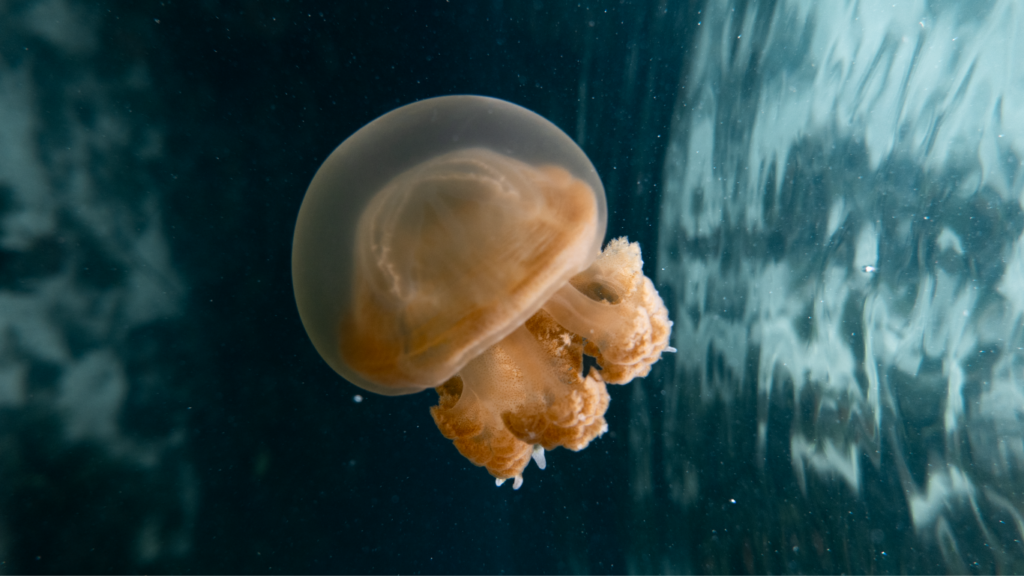
At first glance, the idea sounds almost impossible. A lake in the middle of the ocean, filled with jellyfish that do not sting.
Yet that is exactly what you will find at Kakaban Jellyfish Lake, located in the Derawan Archipelago.
This unusual ecosystem has fascinated scientists and travelers alike. The lake sits on top of Kakaban Island, surrounded by the sea, but completely separated from it. Inside the lake lives a population of jellyfish that have evolved in isolation for thousands of years.
Understanding how Kakaban Jellyfish Lake formed and why its jellyfish do not sting reveals just how extraordinary this place truly is.
Kakaban Jellyfish Lake is what scientists call a marine lake. These lakes were formed thousands of years ago when sea levels changed and parts of the ocean became trapped inside islands.
Over time, the connection between the sea and the lake closed or became extremely limited. The water remained saltwater, but the ecosystem inside began to evolve independently.
Kakaban Island itself is a raised coral island. As geological movements lifted the reef above sea level, seawater became trapped inside natural depressions. This created a lagoon that slowly transformed into the lake we see today.
Even though Kakaban Jellyfish Lake is surrounded by the ocean, it is now an isolated world with its own environmental balance.
The jellyfish inside Kakaban Jellyfish Lake belong mostly to species of golden jellyfish and moon jellyfish. Normally, these animals use stinging cells to catch prey and defend themselves.
But inside the lake, things evolved differently.
Because there are almost no natural predators and very little competition for food, the jellyfish gradually lost the need for strong stinging cells. Over thousands of years, their stings became extremely weak.
For visitors swimming in the lake, this means the jellyfish feel harmless. Most people do not feel any sting at all.
This unusual evolutionary path is what makes Kakaban Jellyfish Lake so special.
Marine lakes like Kakaban are incredibly rare. Scientists estimate that there are only a handful of jellyfish lakes like this in the world.
The most famous examples are found in:
Each lake has its own species and unique ecological conditions.
Kakaban Jellyfish Lake is considered one of the largest and most accessible of these ecosystems, which makes it an important natural site for research and conservation.
Visitors can reach Kakaban Island by boat from the surrounding islands of the Derawan Archipelago. After arriving, a short wooden walkway leads up through the forest and down to the lake.
Stepping onto the viewing platform and seeing thousands of jellyfish drifting silently through the water is a moment many travelers remember for years.
Swimming among them is an experience unlike anything else in the ocean. Instead of avoiding jellyfish, you move gently among them as they pulse slowly through the water.
Because the ecosystem is extremely fragile, visitors are asked to follow simple rules to protect it. Touching the jellyfish, wearing sunscreen in the lake, or disturbing the animals is discouraged to keep the habitat healthy.
Many travelers exploring the Derawan Archipelago choose to include Kakaban in their itinerary.
The island is often visited as part of day trips that combine several iconic locations in the region.
Guests staying with Scuba Junkie Sangalaki regularly explore Kakaban alongside other nearby highlights such as manta cleaning stations, vibrant coral reefs, and turtle-rich dive sites.
Combining diving with unique natural experiences like Kakaban Jellyfish Lake gives visitors a deeper appreciation for the diversity of the Derawan Archipelago.
Kakaban Jellyfish Lake is more than a beautiful place. It is a reminder of how isolated ecosystems can evolve in surprising ways.
The jellyfish living here have adapted to their environment over thousands of years. Protecting this fragile ecosystem ensures that future generations will also have the chance to witness it.
When visiting places like Kakaban, responsible tourism plays an important role. Respectful swimming, careful movement in the water, and following local guidelines all help preserve the lake.
The idea of a lake in the middle of the ocean filled with jellyfish that do not sting sounds almost like a myth. Yet Kakaban Jellyfish Lake proves that nature still holds many surprises.
For travelers exploring the Derawan Archipelago, visiting this unique marine lake offers a chance to experience one of the rarest ecosystems on Earth.
And sometimes the most memorable moments of a trip happen not only underwater with dive gear, but floating quietly in a lake surrounded by thousands of gentle jellyfish.
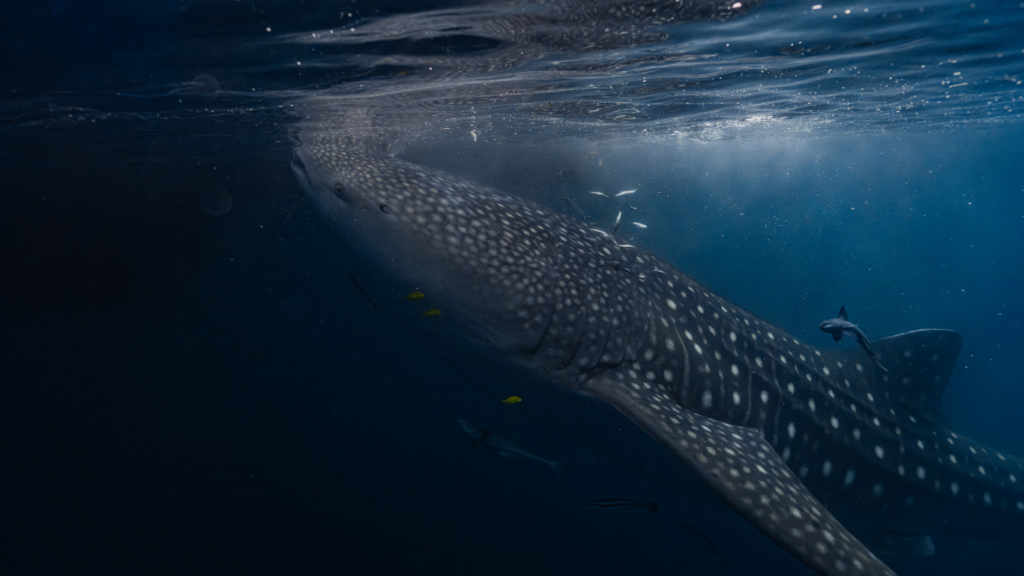
A whale shark trip in Derawan is often described as one of the most special experiences you can have while visiting this remote corner of Indonesia. It can also be one of the most misunderstood. This is not a guaranteed encounter, not a zoo-like experience, and not something that runs on a fixed schedule.
Instead, it’s an early-morning adventure shaped by lunar phases, fishing traditions, weather, and the natural behavior of wild animals. When conditions align, the reward can be extraordinary. This article explains honestly how the trip works, why timing matters, and what guests should realistically expect.
The night before a whale shark trip in Derawan, local captains confirm whether whale sharks have been spotted and where the fishing platforms are located. Depending on the season, this can be:
You’ll be asked to prepare your snorkelling gear the evening before, either in your room or on the jetty, so you’re ready to leave early.
Departure is very early, usually around 4:30 am, to reach the area during peak feeding time and before other boats arrive. The sunrise boat ride is often one of the quiet highlights of the trip.
Once at the fishing platforms, captains communicate with fishermen to locate where whale sharks have been seen. This can involve moving between several platforms before entering the water.
Bagans are traditional floating fishing platforms used by local fishermen. At night, lights attract small fish—mainly anchovies—which are then harvested in the early morning.
Whale sharks are drawn to this activity because of the concentration of food. These platforms are not built for tourism, and their locations change depending on season, wind, and sea conditions. This is why the distance and duration of a whale shark trip in Derawan can vary from day to day.
Whale sharks visit this area for one simple reason: food availability.
Around the new moon, nights are darker. Small fish stay closer to the surface and gather more densely around the bagans. This creates a feeding opportunity that whale sharks take advantage of.
Yes, technically, whale sharks are fed when they are already present. If a whale shark arrives and guests are in the water, fishermen may release extra anchovies—or sometimes even just water. Whale sharks are not particularly smart and still respond as if food is available, which keeps them around briefly.
Importantly:
They are not resident animals, trained, or conditioned to stay.
During the full moon, conditions change:
This is why the days leading up to and just after the new moon offer the best chances for a whale shark trip in Derawan.
While sightings are never guaranteed, planning your stay around the new moon can improve your chances.
| Month | New Moon Date | Best Viewing Window |
|---|---|---|
| January | 12 Jan 2026 | 10–14 Jan |
| February | 11 Feb 2026 | 9–13 Feb |
| March | 12 Mar 2026 | 10–14 Mar |
| April | 10 Apr 2026 | 8–12 Apr |
| May | 10 May 2026 | 8–12 May |
| June | 8 Jun 2026 | 6–10 Jun |
| July | 8 Jul 2026 | 6–10 Jul |
| August | 6 Aug 2026 | 4–8 Aug |
| September | 5 Sep 2026 | 3–7 Sep |
| October | 4 Oct 2026 | 2–6 Oct |
| November | 3 Nov 2026 | 1–5 Nov |
| December | 2 Dec 2026 | 30 Nov–4 Dec |
Planning tip: Aim to be in Derawan 2 days before to 2 days after the new moon.
This excursion is run entirely by the local community. Scuba Junkie does not operate the trip, does not profit from it, and does not take advance bookings.
All arrangements are made once you are on the island, allowing our team to check weather, moon phase, and availability with the local captains. Supporting this trip helps provide alternative livelihoods and long-term protection for the area.
Trips to Talisayan return around midday, which means you will not be able to join dive boats that day.
Although Scuba Junkie does not operate the trip, we expect all guests to follow strict guidelines:
Whale sharks may approach very closely, sometimes swimming directly toward snorkellers. This can feel intense, but they pose no threat to humans. Any guest who touches a whale shark will be removed from the water for the remainder of the trip.
Is the trip guaranteed?
No. Whale sharks are wild animals and sightings depend on many factors.
How early do we leave?
Usually around 4:30 am.
Can I book in advance?
No. Trips are arranged on the island only.
Will I miss diving?
Possibly. Short trips may allow you to join Dive 1; longer trips start from Dive 2 or 3.
What should I bring?
Mask, snorkel, fins, and optional warm layers and snacks.
A whale shark trip in Derawan is raw, early, unpredictable, and deeply special when it works. Understanding how it functions—from bagans to moon phases—helps guests arrive with the right expectations.
Go for the experience, not the promise. Respect the animals, the fishermen, and the rhythm of nature. That’s when the trip becomes truly unforgettable.
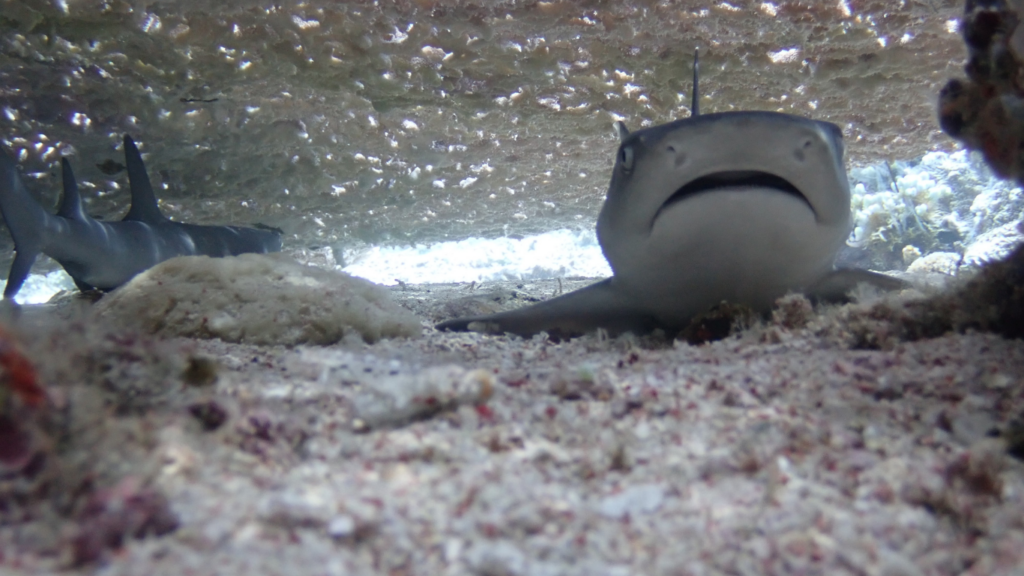
Diving with sharks in the Derawan Archipelago doesn’t usually feel dramatic or staged—and that’s exactly what makes it special.
Rather than high-adrenaline encounters, shark sightings here tend to feel natural and unforced. Sharks appear as part of the reef scene: cruising along drop-offs, resting on sandy patches, or passing through the blue at the edge of visibility. For many divers, especially those with experience, this kind of encounter feels far more rewarding than a choreographed spectacle.
One of the strengths of diving with sharks in the Derawan Archipelago is the diversity of species you may encounter over time.
Common and regularly seen species include:
With patience—and a bit of luck—you may also encounter:
These pelagic species are rare, but their occasional appearances are what make long stays particularly exciting.
On top of that, divers and snorkellers sometimes spot:
This range—from small, cryptic species to large, open-water sharks—speaks volumes about the health of the ecosystem.
Sharks in the Derawan Archipelago behave like sharks should.
They are not conditioned to divers, boats, or feeding. As a result, encounters often feel calm and brief—yet memorable. Sharks may circle once, glide past, or remain at a comfortable distance before disappearing again.
This behaviour is shaped by:
For divers who enjoy reading the reef and scanning the blue, these moments are deeply satisfying.
Shark sightings in the Derawan Archipelago often occur:
Some species, like whitetip reef sharks, are often seen resting, while others cruise steadily through open water. Paying attention to the environment—rather than actively searching—often leads to the best encounters.
The presence of sharks in the Derawan Archipelago is a strong indicator of reef health.
As predators, sharks help maintain balance by:
Seeing sharks regularly—even briefly—means the reef is functioning as a whole, interconnected system.
Shark encounters are rarely about one specific dive. They tend to build over time.
Divers who stay longer:
Those rare sightings—thresher sharks, hammerheads, leopard sharks—often happen when expectations are relaxed and awareness is high.
Guests don’t usually describe sharks here by size or number.
Instead, they remember:
These are the kinds of encounters that feel authentic—and they tend to stay with divers long after the trip ends.
Sharks in the Derawan Archipelago aren’t a headline attraction—they’re part of a larger, healthy marine environment.
From reef-associated species to rare pelagic visitors, the diversity here rewards patience, curiosity, and time. For divers willing to slow down and stay present, shark encounters become moments of connection rather than spectacle.
And sometimes, the most memorable sightings are the ones you didn’t expect at all.
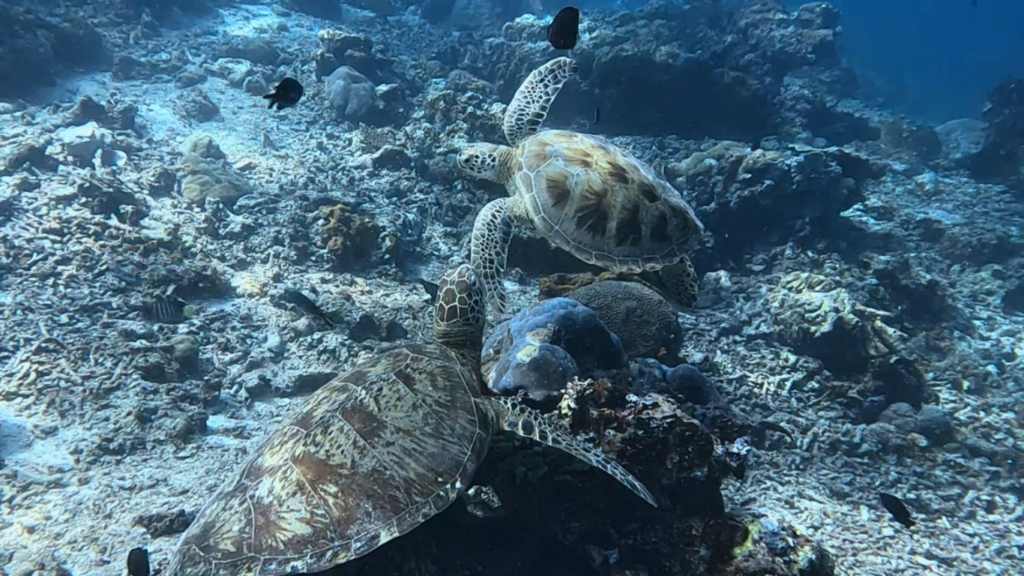
In many dive destinations, seeing a turtle is a highlight. Something you hope for, look out for, and maybe count proudly at the end of the dive.
With turtles in the Derawan Archipelago, that mindset doesn’t last very long.
Here, turtles are not an occasional reward. They are part of daily underwater life. After a few days of diving, most guests realise they’ve stopped counting turtles altogether—not because they’ve lost interest, but because turtles have become normal. And in today’s oceans, that kind of normality is rare and worth protecting.
The first dives are usually full of excitement. One turtle cruising past. Another resting on the reef. A third gliding up for air.
But diving among turtles in the Derawan Archipelago shifts your focus. Instead of counting sightings, you start observing behaviour. You notice how calm they are, how little effort they use to move, and how comfortable they seem sharing space with divers.
This change doesn’t happen everywhere—and it tells you something important about the ecosystem.
Within the Derawan Archipelago, one island consistently stands out when it comes to turtle encounters: Maratua Island.
On the right dive, at the right site, seeing dozens of turtles on a single dive is possible. Divers often surface laughing, trying—and failing—to remember how many turtles passed by. At some sites, numbers can reach levels where counting simply becomes pointless.
This is where the phrase “you’ll stop counting” truly becomes reality.
While Maratua may offer the highest concentration, turtles in the Derawan Archipelago are found across all islands.
You’ll see them:
And very often, right underneath the water bungalows.
Between dives, turtles are frequently spotted grazing on seagrass below the jetty or surfacing quietly next to the bungalows. They are big, relaxed, and clearly at home. Watching them go about their day without urgency is one of the understated pleasures of staying in Derawan.
Turtles don’t remain relaxed in places where they are constantly disturbed.
One reason encounters with turtles in the Derawan Archipelago feel so unrushed is because these animals are not pressured. They are not chased, touched, or surrounded. Over time, this lack of stress shapes behaviour.
Divers often notice:
For experienced divers, these details are often more meaningful than dramatic encounters.
When turtles are rare, they become something to chase.
When turtles are abundant, they become something to learn from.
Diving with turtles in the Derawan Archipelago encourages a slower pace. Divers drift instead of pursue. Observation replaces interaction. The reef becomes a place to settle into rather than rush through.
This is the kind of diving that rewards patience—and it tends to stay with people long after the trip ends.
Here’s where the picture comes together.
Some of the most turtle-rich sites—particularly around Maratua—are accessed when guests commit to longer dive stays. This isn’t about exclusivity; it’s about distance, logistics, and making the journey worthwhile.
Guests who stay longer:
For many, extending their stay transforms turtles from a bucket-list item into a familiar presence.
Many guests arrive hoping to see a turtle.
By the end of their stay, especially after multiple days diving among turtles in the Derawan Archipelago, that hope quietly shifts. Turtles become part of the background—something you notice between dives, beneath your bungalow, or during surface intervals.
At some point, you realise you never asked how many you saw that day.
You didn’t need to.
Stopping the count doesn’t mean taking turtles for granted. It means recognising how unusual it is for abundance to feel ordinary.
In the Derawan Archipelago, turtles aren’t performing for visitors. They’re simply living their lives. Being able to witness that—day after day—is a privilege that only exists where ecosystems are still functioning well.
If staying a little longer gives you the chance to experience that rhythm fully, it might just be worth it.
Some destinations reward patience.
Diving with turtles in the Derawan Archipelago is one of them.
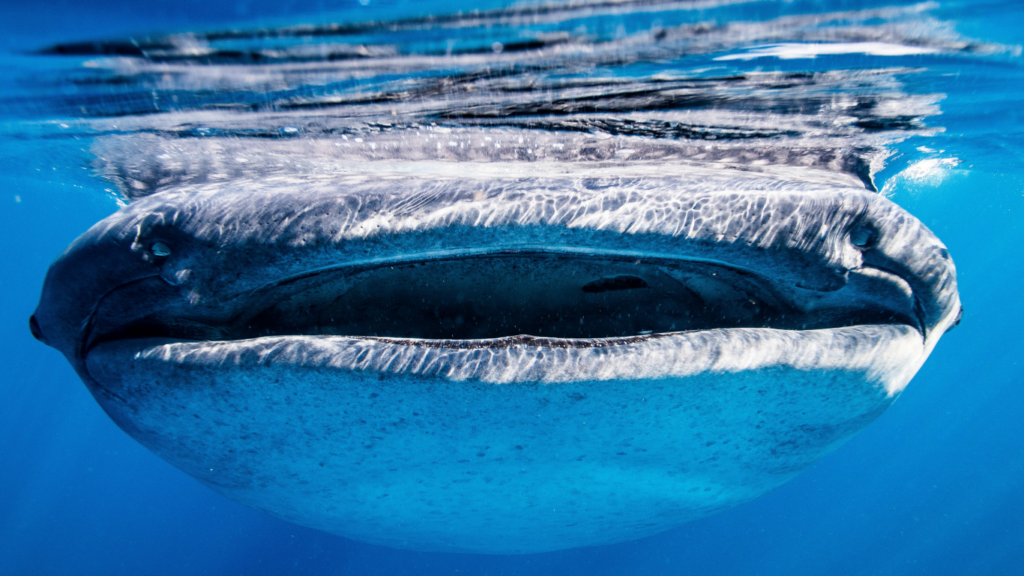
A whale shark trip in Derawan is one of those experiences many divers and snorkelers dream about—but it’s also one that works a little differently from what people often imagine. This is not a theme-park encounter, not a guaranteed sighting, and not something that can be booked months in advance.
Instead, it’s an early-morning adventure shaped by tides, moon phases, fishermen, weather, and a lot of patience. When everything aligns, the reward can be extraordinary: sharing the water with the largest fish in the ocean as the sun rises over the sea.
This blog is here to explain, honestly and clearly, what you can expect if you choose to join this trip while staying with Scuba Junkie Sangalaki on Derawan Island.
The night before your whale shark trip in Derawan, the local captains confirm whether whale sharks have been spotted and where the fishing platforms (bagans) are located. Depending on the time of year and conditions, this can be:
You’ll be asked to prepare your snorkelling gear in advance—either in your room or on the jetty—so everything is ready for a very early start.
Your alarm will be set early. Very early. Boats usually depart around 4:30 am, aiming to reach the bagans before other boats arrive and during the peak feeding window.
As the boat moves through the calm morning sea, you’ll watch the sunrise—often one of the quiet highlights of the trip. Once near the fishing platforms, captains communicate with fishermen and other boats to locate where whale sharks have been seen. This may involve moving between several bagans.
When whale sharks are spotted, you’ll enter the water to snorkel with them.
Whale sharks come to this area because of anchovies. These small fish gather around the fishing platforms, and whale sharks take advantage of the easy food source.
It’s important to be transparent here: the whale sharks are being fed indirectly, as fishermen release anchovies while fishing. This is why sightings are relatively reliable during certain lunar phases—especially around the New Moon.
However, research and long-term observation indicate that this feeding does not change the whale sharks’ natural behaviour or migration patterns. They come and go freely, stay for varying lengths of time, and continue their normal movements through the region.
They are not captive, trained, or controlled in any way—and that’s also why sightings are never guaranteed.
This is a key point: Scuba Junkie does not operate this excursion.
The whale shark trip in Derawan is:
Scuba Junkie makes no money from this trip and does not take responsibility or liability for it. We also don’t take advance bookings. All arrangements are made once you are on the island, allowing our team to check conditions, moon phase, and availability with the local captains.
Supporting this trip means supporting alternative livelihoods for the community—one of the most effective ways to protect whale sharks and their habitat long-term.
Prices depend on location:
When trips go to Talisayan, departure is around 5:00 am, and return is usually around midday, which means you won’t be able to join the dive boats that day.
Once everyone has had enough time in the water, the boat heads back to Derawan.
Either way, it’s an early start followed by a very full day.
Scuba Junkie is an eco dive centre, and although we don’t run this excursion, we expect all guests to follow strict guidelines:
Whale sharks may come very close—sometimes directly towards you with mouths open. This can feel intense, but they pose no threat to humans. Still, touching them is strictly forbidden.
Any guest who touches a whale shark will be removed from the water for the remainder of the trip.
There are very few places left in the world where encounters like this still happen naturally. Respect is what allows them to continue.
A whale shark trip in Derawan is not guaranteed. It depends on weather, moon phase, location of the bagans, and whether the whale sharks decide to show up that morning.
But when it works, it’s quiet, raw, and genuinely special—no crowds, no cages, no choreography. Just early light, calm water, and the chance to share space with one of the ocean’s most gentle giants.
If you choose to go, go with patience, respect, and realistic expectations. That’s when the experience truly delivers.