



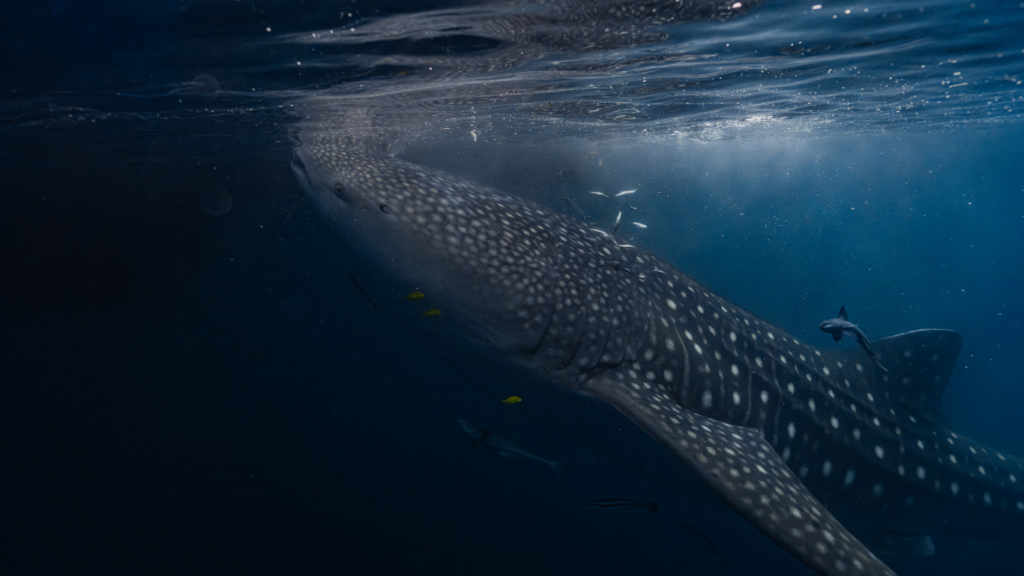
A whale shark trip in Derawan is often described as one of the most special experiences you can have while visiting this remote corner of Indonesia. It can also be one of the most misunderstood. This is not a guaranteed encounter, not a zoo-like experience, and not something that runs on a fixed schedule.
Instead, it’s an early-morning adventure shaped by lunar phases, fishing traditions, weather, and the natural behavior of wild animals. When conditions align, the reward can be extraordinary. This article explains honestly how the trip works, why timing matters, and what guests should realistically expect.
The night before a whale shark trip in Derawan, local captains confirm whether whale sharks have been spotted and where the fishing platforms are located. Depending on the season, this can be:
You’ll be asked to prepare your snorkelling gear the evening before, either in your room or on the jetty, so you’re ready to leave early.
Departure is very early, usually around 4:30 am, to reach the area during peak feeding time and before other boats arrive. The sunrise boat ride is often one of the quiet highlights of the trip.
Once at the fishing platforms, captains communicate with fishermen to locate where whale sharks have been seen. This can involve moving between several platforms before entering the water.
Bagans are traditional floating fishing platforms used by local fishermen. At night, lights attract small fish—mainly anchovies—which are then harvested in the early morning.
Whale sharks are drawn to this activity because of the concentration of food. These platforms are not built for tourism, and their locations change depending on season, wind, and sea conditions. This is why the distance and duration of a whale shark trip in Derawan can vary from day to day.
Whale sharks visit this area for one simple reason: food availability.
Around the new moon, nights are darker. Small fish stay closer to the surface and gather more densely around the bagans. This creates a feeding opportunity that whale sharks take advantage of.
Yes, technically, whale sharks are fed when they are already present. If a whale shark arrives and guests are in the water, fishermen may release extra anchovies—or sometimes even just water. Whale sharks are not particularly smart and still respond as if food is available, which keeps them around briefly.
Importantly:
They are not resident animals, trained, or conditioned to stay.
During the full moon, conditions change:
This is why the days leading up to and just after the new moon offer the best chances for a whale shark trip in Derawan.
While sightings are never guaranteed, planning your stay around the new moon can improve your chances.
| Month | New Moon Date | Best Viewing Window |
|---|---|---|
| January | 12 Jan 2026 | 10–14 Jan |
| February | 11 Feb 2026 | 9–13 Feb |
| March | 12 Mar 2026 | 10–14 Mar |
| April | 10 Apr 2026 | 8–12 Apr |
| May | 10 May 2026 | 8–12 May |
| June | 8 Jun 2026 | 6–10 Jun |
| July | 8 Jul 2026 | 6–10 Jul |
| August | 6 Aug 2026 | 4–8 Aug |
| September | 5 Sep 2026 | 3–7 Sep |
| October | 4 Oct 2026 | 2–6 Oct |
| November | 3 Nov 2026 | 1–5 Nov |
| December | 2 Dec 2026 | 30 Nov–4 Dec |
Planning tip: Aim to be in Derawan 2 days before to 2 days after the new moon.
This excursion is run entirely by the local community. Scuba Junkie does not operate the trip, does not profit from it, and does not take advance bookings.
All arrangements are made once you are on the island, allowing our team to check weather, moon phase, and availability with the local captains. Supporting this trip helps provide alternative livelihoods and long-term protection for the area.
Trips to Talisayan return around midday, which means you will not be able to join dive boats that day.
Although Scuba Junkie does not operate the trip, we expect all guests to follow strict guidelines:
Whale sharks may approach very closely, sometimes swimming directly toward snorkellers. This can feel intense, but they pose no threat to humans. Any guest who touches a whale shark will be removed from the water for the remainder of the trip.
Is the trip guaranteed?
No. Whale sharks are wild animals and sightings depend on many factors.
How early do we leave?
Usually around 4:30 am.
Can I book in advance?
No. Trips are arranged on the island only.
Will I miss diving?
Possibly. Short trips may allow you to join Dive 1; longer trips start from Dive 2 or 3.
What should I bring?
Mask, snorkel, fins, and optional warm layers and snacks.
A whale shark trip in Derawan is raw, early, unpredictable, and deeply special when it works. Understanding how it functions—from bagans to moon phases—helps guests arrive with the right expectations.
Go for the experience, not the promise. Respect the animals, the fishermen, and the rhythm of nature. That’s when the trip becomes truly unforgettable.

Visiting during Ramadan in Derawan can feel slightly different from other times of the year, especially if you’re not familiar with the traditions behind it. For some guests, it raises questions. For others, it becomes one of the most memorable parts of their stay.
This blog is here to explain, calmly and openly, what Ramadan is, how it’s observed in Derawan, and what that means for you as a guest staying on the island.
Ramadan is a holy month in Islam, observed by Muslims around the world. It is a time of:
During the day, practicing Muslims do not eat or drink until sunset. In the evening, families and communities gather to break the fast together.
Ramadan follows the lunar calendar, so its dates change every year.
Derawan is a Muslim island, and Ramadan is an important part of life here. That said, daily life does not stop. Boats still run, diving continues, and guests are very welcome.
What you may notice during Ramadan in Derawan is:
For many visitors, this quieter rhythm is actually a pleasant change.
One of the most noticeable aspects of Ramadan in Derawan is the call to prayer coming from the nearby mosque.
The call to prayer happens five times a day, and during Ramadan, early morning prayers can feel more noticeable, especially for light sleepers. Because our water bungalows are made of wood and the island is quiet at night, sound carries easily.
For most guests, the call to prayer quickly becomes part of the background. For some, especially those not used to it, it can be surprising at first.
If you are a light sleeper, we recommend:
It’s not meant to disturb, but to mark moments of reflection and prayer.
Guests are not expected to fast or change their routines during Ramadan in Derawan. Restaurants continue to operate, and diving schedules remain the same.
That said, small gestures of awareness go a long way:
These gestures are never demanded, but they are always appreciated.
Interestingly, many guests who initially worry about visiting during Ramadan end up appreciating it deeply.
They often mention:
For divers in particular, the slower pace pairs beautifully with early nights, sunrise dives, and relaxed surface intervals.
Travel isn’t only about destinations. It’s about timing.
Visiting during Ramadan in Derawan offers a chance to see the island through a different lens. One shaped by tradition, community, and daily rituals that have existed long before tourism arrived.
For guests who are curious and open-minded, it often becomes a meaningful part of their stay.
Ramadan in Derawan is not something to worry about. It’s something to understand.
Knowing what to expect, why certain sounds or rhythms exist, and how the island gently shifts during this time helps guests relax and settle in more easily.
If you ever have questions about Ramadan or island life, our team is always happy to explain. And if you’d like to know more about Ramadan itself, let us know. We’d be happy to share more in a future blog.
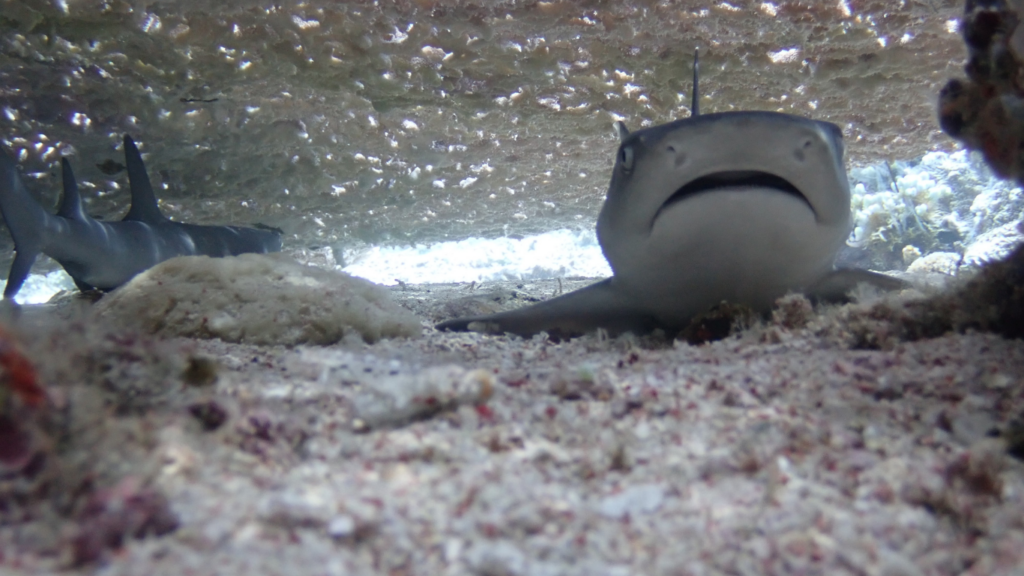
Diving with sharks in the Derawan Archipelago doesn’t usually feel dramatic or staged—and that’s exactly what makes it special.
Rather than high-adrenaline encounters, shark sightings here tend to feel natural and unforced. Sharks appear as part of the reef scene: cruising along drop-offs, resting on sandy patches, or passing through the blue at the edge of visibility. For many divers, especially those with experience, this kind of encounter feels far more rewarding than a choreographed spectacle.
One of the strengths of diving with sharks in the Derawan Archipelago is the diversity of species you may encounter over time.
Common and regularly seen species include:
With patience—and a bit of luck—you may also encounter:
These pelagic species are rare, but their occasional appearances are what make long stays particularly exciting.
On top of that, divers and snorkellers sometimes spot:
This range—from small, cryptic species to large, open-water sharks—speaks volumes about the health of the ecosystem.
Sharks in the Derawan Archipelago behave like sharks should.
They are not conditioned to divers, boats, or feeding. As a result, encounters often feel calm and brief—yet memorable. Sharks may circle once, glide past, or remain at a comfortable distance before disappearing again.
This behaviour is shaped by:
For divers who enjoy reading the reef and scanning the blue, these moments are deeply satisfying.
Shark sightings in the Derawan Archipelago often occur:
Some species, like whitetip reef sharks, are often seen resting, while others cruise steadily through open water. Paying attention to the environment—rather than actively searching—often leads to the best encounters.
The presence of sharks in the Derawan Archipelago is a strong indicator of reef health.
As predators, sharks help maintain balance by:
Seeing sharks regularly—even briefly—means the reef is functioning as a whole, interconnected system.
Shark encounters are rarely about one specific dive. They tend to build over time.
Divers who stay longer:
Those rare sightings—thresher sharks, hammerheads, leopard sharks—often happen when expectations are relaxed and awareness is high.
Guests don’t usually describe sharks here by size or number.
Instead, they remember:
These are the kinds of encounters that feel authentic—and they tend to stay with divers long after the trip ends.
Sharks in the Derawan Archipelago aren’t a headline attraction—they’re part of a larger, healthy marine environment.
From reef-associated species to rare pelagic visitors, the diversity here rewards patience, curiosity, and time. For divers willing to slow down and stay present, shark encounters become moments of connection rather than spectacle.
And sometimes, the most memorable sightings are the ones you didn’t expect at all.
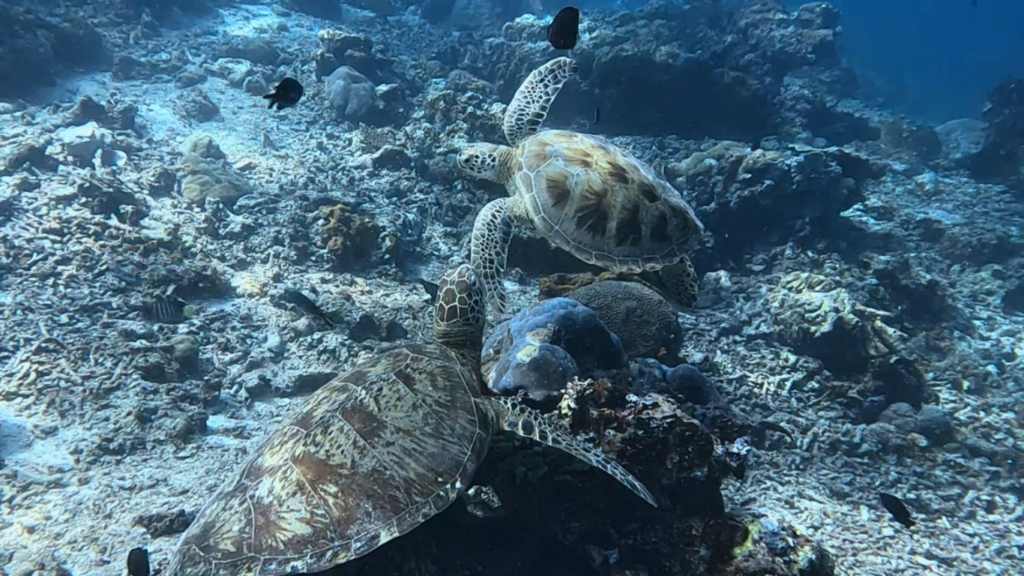
In many dive destinations, seeing a turtle is a highlight. Something you hope for, look out for, and maybe count proudly at the end of the dive.
With turtles in the Derawan Archipelago, that mindset doesn’t last very long.
Here, turtles are not an occasional reward. They are part of daily underwater life. After a few days of diving, most guests realise they’ve stopped counting turtles altogether—not because they’ve lost interest, but because turtles have become normal. And in today’s oceans, that kind of normality is rare and worth protecting.
The first dives are usually full of excitement. One turtle cruising past. Another resting on the reef. A third gliding up for air.
But diving among turtles in the Derawan Archipelago shifts your focus. Instead of counting sightings, you start observing behaviour. You notice how calm they are, how little effort they use to move, and how comfortable they seem sharing space with divers.
This change doesn’t happen everywhere—and it tells you something important about the ecosystem.
Within the Derawan Archipelago, one island consistently stands out when it comes to turtle encounters: Maratua Island.
On the right dive, at the right site, seeing dozens of turtles on a single dive is possible. Divers often surface laughing, trying—and failing—to remember how many turtles passed by. At some sites, numbers can reach levels where counting simply becomes pointless.
This is where the phrase “you’ll stop counting” truly becomes reality.
While Maratua may offer the highest concentration, turtles in the Derawan Archipelago are found across all islands.
You’ll see them:
And very often, right underneath the water bungalows.
Between dives, turtles are frequently spotted grazing on seagrass below the jetty or surfacing quietly next to the bungalows. They are big, relaxed, and clearly at home. Watching them go about their day without urgency is one of the understated pleasures of staying in Derawan.
Turtles don’t remain relaxed in places where they are constantly disturbed.
One reason encounters with turtles in the Derawan Archipelago feel so unrushed is because these animals are not pressured. They are not chased, touched, or surrounded. Over time, this lack of stress shapes behaviour.
Divers often notice:
For experienced divers, these details are often more meaningful than dramatic encounters.
When turtles are rare, they become something to chase.
When turtles are abundant, they become something to learn from.
Diving with turtles in the Derawan Archipelago encourages a slower pace. Divers drift instead of pursue. Observation replaces interaction. The reef becomes a place to settle into rather than rush through.
This is the kind of diving that rewards patience—and it tends to stay with people long after the trip ends.
Here’s where the picture comes together.
Some of the most turtle-rich sites—particularly around Maratua—are accessed when guests commit to longer dive stays. This isn’t about exclusivity; it’s about distance, logistics, and making the journey worthwhile.
Guests who stay longer:
For many, extending their stay transforms turtles from a bucket-list item into a familiar presence.
Many guests arrive hoping to see a turtle.
By the end of their stay, especially after multiple days diving among turtles in the Derawan Archipelago, that hope quietly shifts. Turtles become part of the background—something you notice between dives, beneath your bungalow, or during surface intervals.
At some point, you realise you never asked how many you saw that day.
You didn’t need to.
Stopping the count doesn’t mean taking turtles for granted. It means recognising how unusual it is for abundance to feel ordinary.
In the Derawan Archipelago, turtles aren’t performing for visitors. They’re simply living their lives. Being able to witness that—day after day—is a privilege that only exists where ecosystems are still functioning well.
If staying a little longer gives you the chance to experience that rhythm fully, it might just be worth it.
Some destinations reward patience.
Diving with turtles in the Derawan Archipelago is one of them.
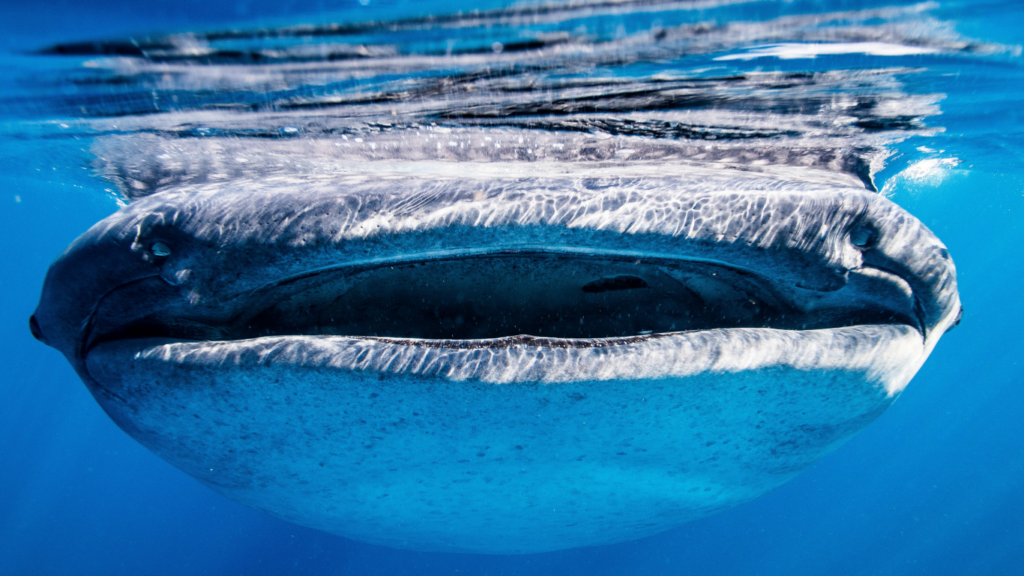
A whale shark trip in Derawan is one of those experiences many divers and snorkelers dream about—but it’s also one that works a little differently from what people often imagine. This is not a theme-park encounter, not a guaranteed sighting, and not something that can be booked months in advance.
Instead, it’s an early-morning adventure shaped by tides, moon phases, fishermen, weather, and a lot of patience. When everything aligns, the reward can be extraordinary: sharing the water with the largest fish in the ocean as the sun rises over the sea.
This blog is here to explain, honestly and clearly, what you can expect if you choose to join this trip while staying with Scuba Junkie Sangalaki on Derawan Island.
The night before your whale shark trip in Derawan, the local captains confirm whether whale sharks have been spotted and where the fishing platforms (bagans) are located. Depending on the time of year and conditions, this can be:
You’ll be asked to prepare your snorkelling gear in advance—either in your room or on the jetty—so everything is ready for a very early start.
Your alarm will be set early. Very early. Boats usually depart around 4:30 am, aiming to reach the bagans before other boats arrive and during the peak feeding window.
As the boat moves through the calm morning sea, you’ll watch the sunrise—often one of the quiet highlights of the trip. Once near the fishing platforms, captains communicate with fishermen and other boats to locate where whale sharks have been seen. This may involve moving between several bagans.
When whale sharks are spotted, you’ll enter the water to snorkel with them.
Whale sharks come to this area because of anchovies. These small fish gather around the fishing platforms, and whale sharks take advantage of the easy food source.
It’s important to be transparent here: the whale sharks are being fed indirectly, as fishermen release anchovies while fishing. This is why sightings are relatively reliable during certain lunar phases—especially around the New Moon.
However, research and long-term observation indicate that this feeding does not change the whale sharks’ natural behaviour or migration patterns. They come and go freely, stay for varying lengths of time, and continue their normal movements through the region.
They are not captive, trained, or controlled in any way—and that’s also why sightings are never guaranteed.
This is a key point: Scuba Junkie does not operate this excursion.
The whale shark trip in Derawan is:
Scuba Junkie makes no money from this trip and does not take responsibility or liability for it. We also don’t take advance bookings. All arrangements are made once you are on the island, allowing our team to check conditions, moon phase, and availability with the local captains.
Supporting this trip means supporting alternative livelihoods for the community—one of the most effective ways to protect whale sharks and their habitat long-term.
Prices depend on location:
When trips go to Talisayan, departure is around 5:00 am, and return is usually around midday, which means you won’t be able to join the dive boats that day.
Once everyone has had enough time in the water, the boat heads back to Derawan.
Either way, it’s an early start followed by a very full day.
Scuba Junkie is an eco dive centre, and although we don’t run this excursion, we expect all guests to follow strict guidelines:
Whale sharks may come very close—sometimes directly towards you with mouths open. This can feel intense, but they pose no threat to humans. Still, touching them is strictly forbidden.
Any guest who touches a whale shark will be removed from the water for the remainder of the trip.
There are very few places left in the world where encounters like this still happen naturally. Respect is what allows them to continue.
A whale shark trip in Derawan is not guaranteed. It depends on weather, moon phase, location of the bagans, and whether the whale sharks decide to show up that morning.
But when it works, it’s quiet, raw, and genuinely special—no crowds, no cages, no choreography. Just early light, calm water, and the chance to share space with one of the ocean’s most gentle giants.
If you choose to go, go with patience, respect, and realistic expectations. That’s when the experience truly delivers.
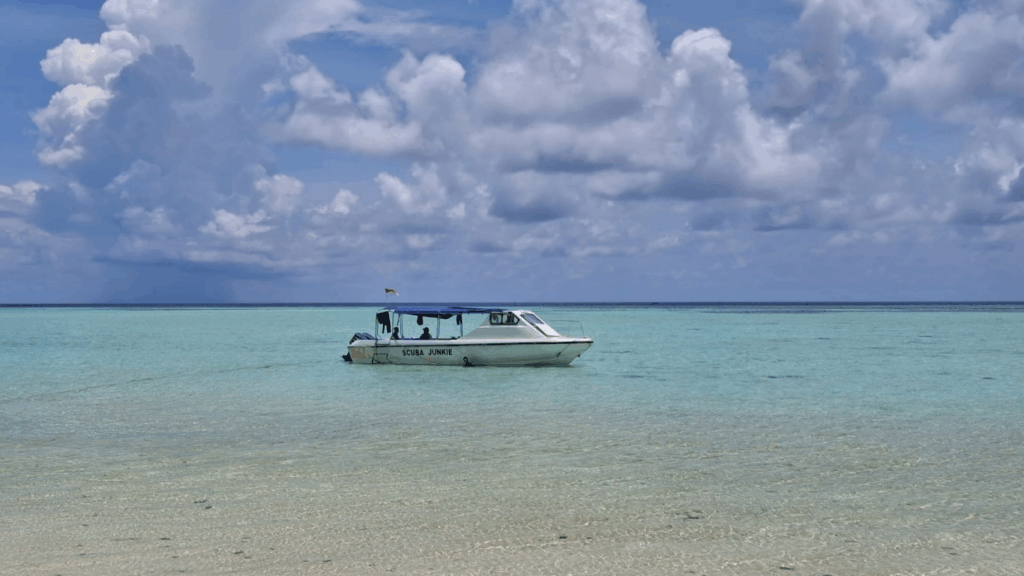
You’ve made it all the way to Derawan, and this trip has probably been planned for a long time. Don’t forget to bring in Derawan isn’t meant as pressure—it’s simply a gentle reminder that while this island is charming, peaceful, and beautiful, it’s also remote. And in remote places, the fewer surprises, the better.
So here’s a friendly guide to help you arrive prepared. These aren’t dramatic warnings or scary details—just small things that often catch travelers off guard, and simple solutions that make your stay more comfortable. Pack smart, adapt easily, and you’ll enjoy this lovely corner of the world even more.
Tropical islands come with tropical insects. Derawan is no exception. A small bottle of mosquito spray makes evenings more comfortable and keeps the post-sunset itching away. Simple, but genuinely helpful.
Indonesia uses Type C/F two-round-pin plugs at 230V. If your devices use a different type, bring a universal adapter. With limited shops on the island, it’s better to arrive with the right one than go searching later.
The sun here can be strong, and reef-safe sunscreen is best for both your skin and the marine environment.
But even better? UV-protective shirts and rashguards.
These keep you protected without needing to reapply sunscreen every couple of hours. They’re comfortable, reliable, and far more eco-friendly. Between a long-sleeve UPF top and a good hat, you’re set for long boat days.
Derawan has limited banking services, and many local shops and small businesses are cash only.
Our booking team can give you a helpful estimate of how much you’ll need during your stay, and you can withdraw that amount at an ATM before starting your trip to Derawan, including easily at the airport.
Having enough Rupiah on hand saves time and avoids last-minute stress.
Our overwater bungalows and walkways are built from wood, which means sound travels. Passing boats, waves under the deck, and the call to prayer from the nearby mosque are part of the island’s natural rhythm. Most guests find these sounds peaceful, but if you wake easily, ear plugs can make a big difference.
During Ramadan, the holiest month for Muslims, mornings may be slightly livelier as the community observes fasting and prayer. It’s a beautiful time on the island, but again—ear plugs are a great idea.
If you’d like to understand more about Ramadan and its customs, let us know—we’ll be happy to create a dedicated blog for you.
Derawan is stunning, but like all islands, it’s sensitive to waste. A reusable bottle and a small travel cup are perfect for boat days, coffee runs, and reducing plastic use during your stay. It’s a small gesture with a big impact.
Ps; Small presents for the staff are always welcome 😉
We require all divers to have valid dive insurance—not because diving is dangerous, but because Derawan is remote. Getting here involves flights, cars, and boats, and this distance is part of the charm. But in the rare event of a dive-related emergency, it also means medical facilities are far away.
The closest hyperbaric chamber is in Balikpapan, and emergency treatments are never cheap. Short-term DAN policies are affordable and tailored for divers, offering peace of mind so you can enjoy your holiday without thinking about the “what-ifs.”
To reassure you: Scuba Junkie Sangalaki has never had a dive accident that required evacuation.
We dive the Scuba Junkie way, which means:
This ultra-conservative approach keeps diving safe, relaxed, and enjoyable. When done responsibly, scuba diving is a very safe sport—and you’re in excellent hands with our team.
Coffee lovers will be pleased: Derawan has several great cafés. Indonesia is a coffee-loving nation, so you’ll find plenty of good brews—iced, hot, or sweet local variations. Our manager is always happy to share recommendations.
Our accommodation packages include breakfast and lunch on your dive days. Dinner is enjoyed outside the resort, giving you flexibility to explore.
If nothing on the menu calls to you one evening, head to the local vegetable stalls. Pick what you like, bring it to a restaurant, and they’ll cook it for you—fresh, simple, and unique. A fun way to customise your meal.
A relaxing massage is a perfect end-of-trip treat. We can arrange a session with a trusted local therapist who provides treatments at the resort, so you won’t even need to leave your bungalow. It’s a soothing, gentle way to unwind after your holiday’s adventures.
Derawan is beautiful, welcoming, and full of surprises in the best way. Most divers who travel this far are adventurous, adaptable, and excited for something different. But if you’re someone who enjoys a bit more comfort, that’s completely fine too.
A few small essentials from home, an open mind for a different pace, and appreciation for local culture go a long way. The beauty of Derawan truly is in every corner—morning light, friendly faces, turtles gliding past the jetties, and calm evenings spent over the water.
Plan well, pack thoughtfully, and let the island do the rest.
Yes—many small businesses are cash only. Withdraw before arriving; airport ATMs work well.
It’s strongly recommended, but UV-protective clothing is an even better solution.
Because wooden structures, boats, and the mosque’s call to prayer can be audible.
Definitely. Derawan has several lovely cafés.
Because we are remote and emergency facilities are far away.
Yes! Many restaurants happily prepare produce you bring from local shops.
Derawan may be remote, but that’s part of its charm. With a few thoughtful items in your bag and a little awareness of island rhythms, your stay becomes smoother, more comfortable, and even more enjoyable. Waves, wildlife, warm people, and simple pleasures make this place special—and with the right preparation, you’ll enjoy it exactly as you imagined.
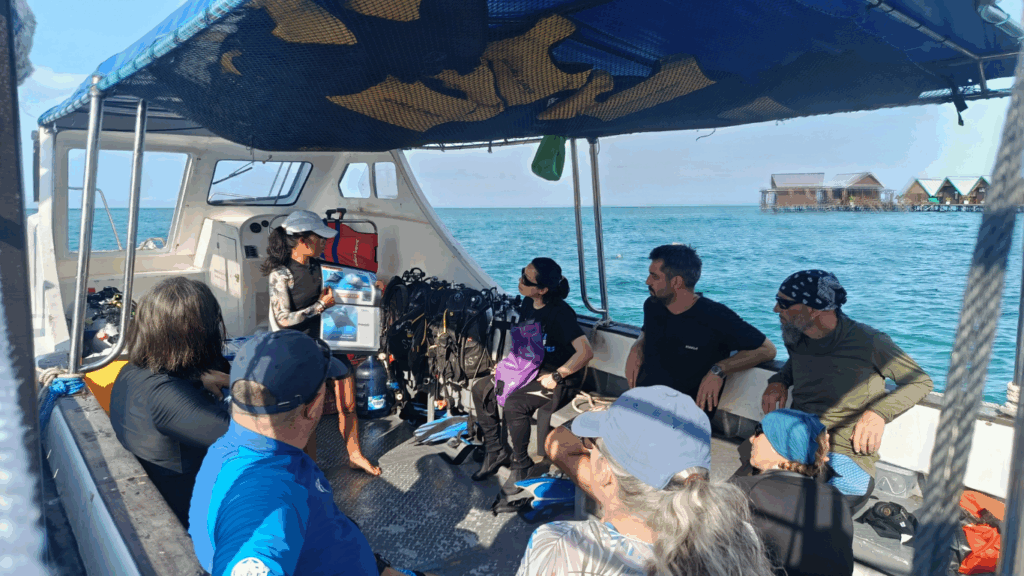
MMF Researchers in Derawan Archipelago
The sun is just rising over Derawan Island. The air is still, the sea calm, and the dive boats are lined up, ready for another day at sea. On the jetty, a small group of people moves with quiet efficiency — tanks clink, notebooks are tucked into waterproof bags, and cameras are checked one last time.
They’re not preparing for an ordinary dive.
They’re preparing for research.
This is what a typical day looks like for the Marine Megafauna Foundation (MMF) researchers in Derawan Archipelago, where every dive, every photo, every note logged underwater adds a new piece to the puzzle of how to protect our ocean’s most iconic species.
The day begins early at the dive center, often side-by-side with the Scuba Junkie Sangalaki team. Researchers help load gear and tanks onto the boats, sharing stories and laughter before the morning briefing.
Before heading out, they gather the divers for a pre-dive talk — not just about safety and currents, but about the species they might encounter: reef manta rays, sea turtles, and leopard sharks.
They explain the goals of their research and teach guests how to interact responsibly with marine megafauna — by keeping a respectful distance, avoiding sudden movements, and never chasing or touching animals.
“Every diver can help,” one researcher says. “It’s not about getting the closest photo — it’s about making every encounter count.”
Once underwater, the work begins. Researchers record environmental data like water temperature, visibility, and current strength, and take note of human impacts such as anchors, coral damage, or plastic debris.
They also perform photo identification — a method where each animal’s unique pattern (a manta’s belly spots or a turtle’s head scales) is photographed and catalogued. These images help track individuals over time, revealing migration patterns, reproductive cycles, and even survival rates.
Some days bring excitement — a manta gliding inches away, a turtle soaring past the reef, or a rare shark silhouette in the blue. Other days, megafauna sightings are scarce. But for scientists, every dive is valuable.
“Even when we don’t see large animals, the data tells us something,” explains Rahvania, one of MMF Researchers in Derawan Archipelago. “By documenting reef health, plankton levels, and human activity, we learn what attracts or drives away species. It all helps us understand how to protect them.”
Not all research happens in the water.
On dry days, the team processes data from previous dives — reviewing photos, updating ID databases, and uploading information into MMF’s global network. These long-term records are crucial for understanding population trends and identifying critical habitats for conservation.
Dry days also mean planning future projects and community outreach. MMF Researchers in Derawan Archipelago works closely with dive centers, local authorities, and schools to raise awareness about sustainable tourism and the importance of protecting marine megafauna.
At Scuba Junkie Sangalaki, this collaboration feels natural. Our guests learn directly from MMF researchers in Derawan Archipelago onboard — even helping photograph mantas and uploading images to MantaMatcher.org, the world’s first global manta ray ID database.
Every dive becomes a shared mission between science, tourism, and conservation.
Just when scientists thought they knew the mantas, the ocean revealed another secret.
In 2020, the Marine Megafauna Foundation and international collaborators officially described a new manta ray species — Mobula yarae — discovered in the Atlantic Ocean off West Africa.
(Read the full MMF article)
This breakthrough reminded researchers how much we still have to learn about these gentle giants. And here in Sangalaki, every new photo, every recorded pregnancy, and every environmental data point brings us closer to understanding the mantas that call East Borneo home.
Marine ecosystems are vast, fragile, and changing fast. Without science-based monitoring, many species could vanish before we even understand their role.
Organizations like MMF are the bridge between exploration and preservation — turning dive sightings into data, and data into protection.
MMF researchers in Derawan Archipelago has already revealed that Sangalaki is a key reproductive site for reef mantas, with 24% of identified females observed pregnant. It’s also a multifunctional habitat, supporting feeding, cleaning, and breeding activities that are essential to the species’ survival.
Science like this doesn’t just protect mantas. It protects everything connected to them — the reefs, the turtles, the sharks, and the people who depend on healthy oceans.
At Scuba Junkie Sangalaki, we’re more than a dive resort — we’re part of a global community of ocean advocates.
Through our partnership with MMF, we provide boats, logistical support, and a platform for researchers to collect data and engage with divers. Guests often dive alongside the scientists, learning how their own encounters contribute to marine protection.
Our conservation commitment runs deep, extending across all Scuba Junkie locations, including our NGO Scuba Junkie SEAS in Sipadan. There, we work with local communities to reduce marine debris, protect nesting turtles, and conduct reef monitoring programs.
Different islands, same mission: to protect the ocean we love.
As the boats return at the end of the day, the sun paints the sea in gold. Researchers rinse their gear, log their notes, and back up the day’s data. Another small piece of the ocean’s story recorded. Another step toward understanding how to protect it.
Science may sound methodical, but here, it feels deeply personal.
It’s about connection — between people and planet, divers and scientists, mantas and those who fight for them.
Every photo, every data point, every shared dive matters. Because understanding the ocean is the first step to saving it.
Would you like to spend a day diving with researchers?
Tell us in the comments what marine species you’d love to learn more about.
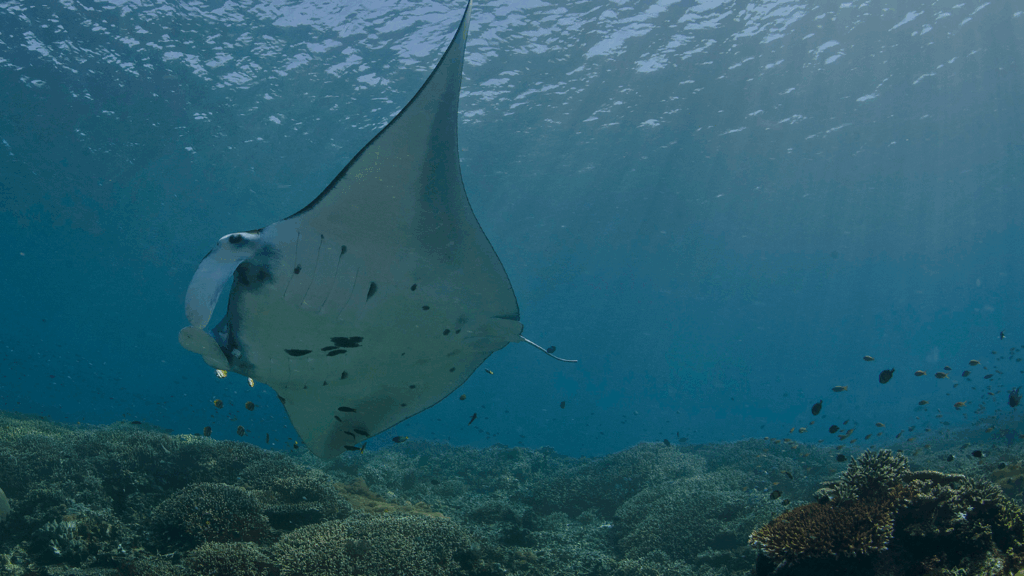
Manta Rays In Sangalaki-
If you’ve ever dived with a manta, you know it’s unforgettable. Their vast wingspans, the effortless glide, the feeling of being close to something both powerful and gentle—it leaves you humbled. This 17th of September, we celebrate World Manta Day, a reminder that these incredible animals still need our help. Let’s dive into the world of mantas, explore their importance, and discover how we can protect them together.
Manta rays belong to the genus Mobula and are related to stingrays and sharks. There are two main species:
These gentle filter-feeders live on a diet of plankton, krill, and small fish larvae. They feed by swimming with their mouths open, filtering the water through special plates called gill rakers. On good days, you might see dozens of them gliding together in feeding chains, creating a scene that feels more like a ballet than biology.
Mantas play an essential role in the balance of marine ecosystems. By feeding on plankton, they help regulate these tiny organisms, which form the base of the ocean’s food web. Their movements between feeding grounds also help cycle nutrients across ecosystems, linking shallow coral reefs to deeper ocean environments.
Equally important, mantas act as ambassadors of the sea. Their charisma draws people into diving and marine conservation. In places like Sangalaki, mantas provide jobs, education, and a strong argument for why healthy oceans matter—not just for biodiversity, but also for communities.
Sadly, manta rays are now listed as vulnerable to extinction by the IUCN. Their populations are decreasing worldwide due to:
In Sangalaki, divers still enjoy year-round manta sightings, but local researchers and guides know that the numbers are not what they once were. Protecting them is not optional—it’s urgent.
The Marine Megafauna Foundation (MMF) has been leading manta ray research in Indonesia since 2011, tracking movements, monitoring populations, and studying threats like plastic pollution. One of their most effective tools is MantaMatcher.org, a global photo-ID database where every manta’s unique belly pattern acts like a fingerprint.
In the Derawan Archipelago, MMF’s work has expanded significantly. Between 2017 and 2019, the team logged 111 research dives during seasonal surveys. In May 2025, they launched a long-term monitoring program, already completing 145 dives this year, with 69 around Sangalaki.
Our boats often carry both divers and scientists together. During trips, MMF researchers share their knowledge with guests—teaching how to take ID photographs and why these images matter. Every photo uploaded helps track individuals across years and oceans, turning divers into contributors to science. It means that every time you dive with us, you’re part of this global effort to protect mantas.
The results so far are impressive. According to Rahvania, one of MMF’s scientists based in Derawan:
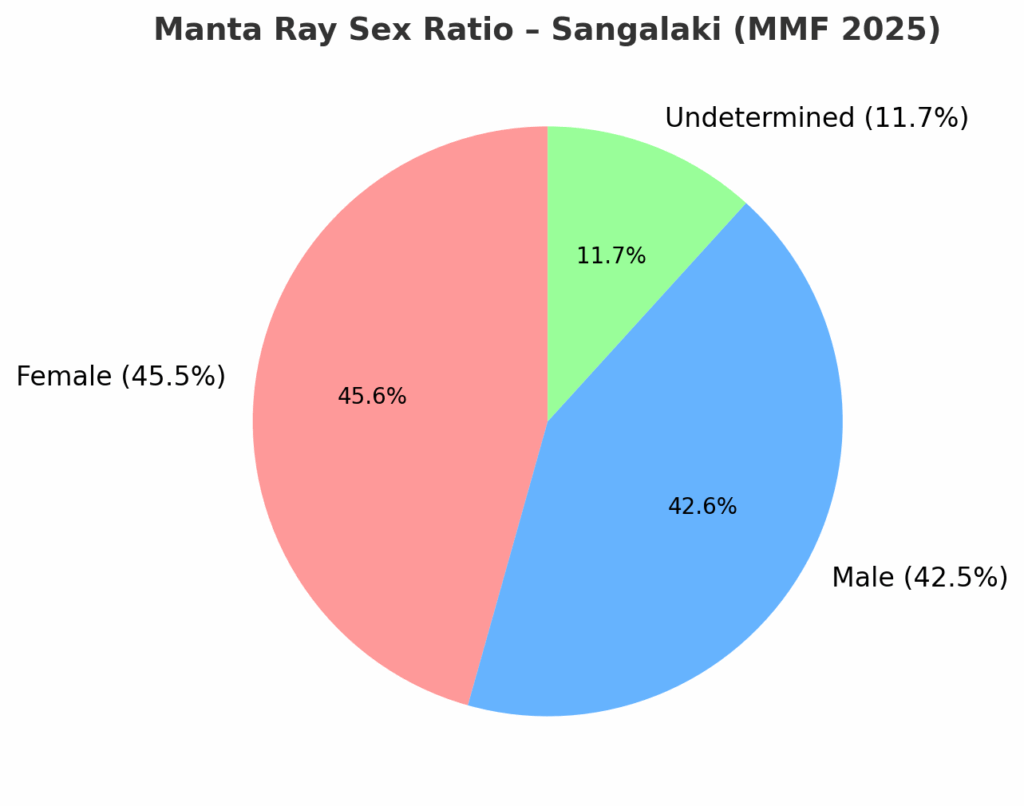
These findings confirm what divers often sense instinctively: Sangalaki is more than just a dive site—it’s a critical habitat where mantas feed, clean, and reproduce.
It’s not all bad news. Where mantas are well protected, populations can recover.
In Raja Ampat, strict marine protected areas have led to a documented 10.7% annual increase in reef manta populations between 2009 and 2019. In Komodo National Park, manta tourism has become a sustainable industry, proving that live mantas are far more valuable to communities than any short-term gain from fishing.
These cases show us what’s possible in Sangalaki and beyond—when science, community, and tourism align.
Not everyone can dive with mantas, but everyone can help them:
There’s a reason why manta rays in Sangalaki are iconic. Few places in the world offer year-round encounters in such a pristine, uncrowded setting. When a manta swoops overhead at Manta Run or circles curiously at a cleaning station, you don’t just see wildlife—you feel connected to something bigger.
World Manta Day reminds us that this connection comes with responsibility. By diving respectfully, supporting research, and spreading the word, we can ensure that these moments remain possible for future generations.
A New Chapter for Manta Science
Just when we think we know them, manta rays surprise us again. In 2020, scientists from the Marine Megafauna Foundation, working with international partners, formally described a new manta species: Mobula yarae, discovered in the Atlantic Ocean off West Africa. This remarkable finding shows us how much there is still to learn about mantas worldwide. Each new discovery adds urgency to protecting known populations, like those in Sangalaki, while reminding us that the ocean still holds mysteries waiting to be uncovered.
(Read the full MMF article here)
Mantas are more than just a dive highlight. They’re indicators of ocean health, sources of income for local communities, and a reminder of how fragile—and how resilient—our blue planet can be.
On September 17th, celebrate World Manta Day with us by learning, sharing, and supporting manta conservation. Whether you’re in the water at Sangalaki or reading this from home, you’re part of the story.
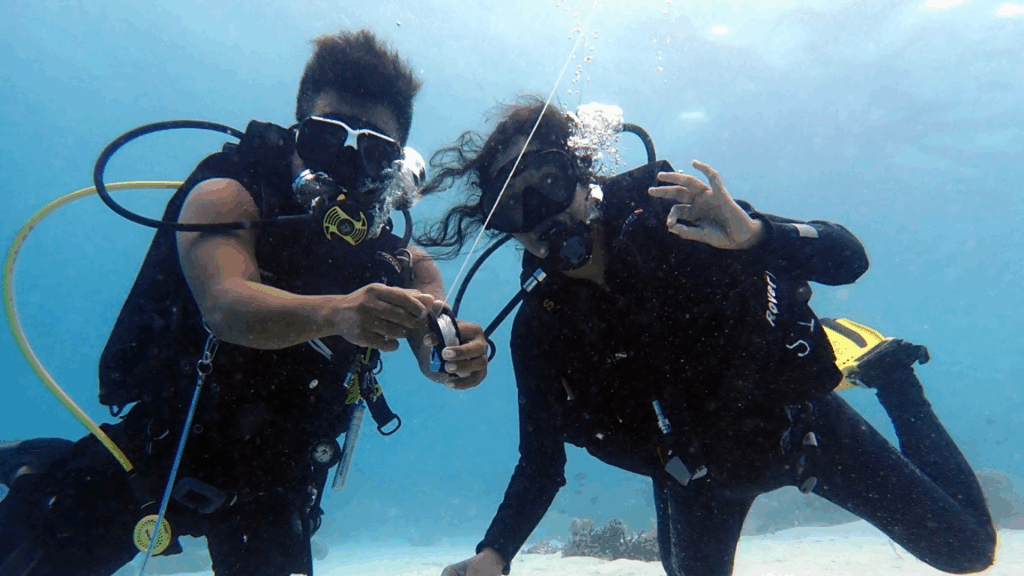
Diving and snorkeling in Derawan islands isn’t just about seeing marine life—it’s about starting your underwater journey in one of the most peaceful, vibrant, and beginner-friendly places in Indonesia. Whether you’re taking your first breath from a regulator or gliding over the reef with just a mask and snorkel, the Derawan Islands offer the kind of calm conditions and rich biodiversity that make every moment unforgettable.
Somewhere off the coast of Borneo, tucked inside the Coral Triangle, lies a small group of islands where the water glows blue, the turtles swim freely, and the reefs feel alive.
If you’ve ever dreamed of learning to dive or finally giving snorkeling a proper go, there may be no better place than here—the Derawan Islands. Remote, uncrowded, and full of marine life, this is one of Indonesia’s best-kept secrets.
This guide is for first-time snorkelers, Discover Scuba Diving (DSD) guests, and those looking to complete their Open Water or Advanced certification in a friendly, low-pressure environment.
The Derawan archipelago includes Derawan, Sangalaki, Kakaban, and Maratua—each with its own charm. Clear water, gentle currents, and a huge variety of marine life make diving and snorkeling in Derawan islands stress-free and inspiring. And because it’s remote, you’ll often have the water to yourself.
The dives here are shallow (often 5–18 meters), the visibility is excellent, and the reefs are full of gentle encounters with turtles, reef fish, and sometimes even manta rays. Many guests even see turtles from their water bungalow before stepping into the sea.
There are no crowds, no pressure, and no chaotic beach scenes. It’s just you, your guide, and a truly magical underwater world waiting to be explored.
Not quite ready to try diving? Snorkeling around the Derawan Islands offers a window into the same beauty—without the tank.
At Sangalaki, you might float just meters above a feeding manta ray. In Derawan’s shallow seagrass beds, you’ll likely spot green turtles gliding by. Off Maratua, healthy coral gardens attract reef fish, stingrays, and even the occasional leopard shark if you’re lucky.
And don’t worry if you’ve never snorkeled before. Our guides are used to beginners and will make sure your gear fits properly, you feel comfortable, and you know exactly how to move and breathe.
If you’ve never dived before but you’re curious, Discover Scuba Diving is your chance to try it without committing to a full course.
You’ll begin in calm, shallow water, close to shore, where you’ll learn how to breathe underwater and practice a few basic skills. Then—once you’re ready—you’ll follow your instructor into the reef, gliding among fish and corals in one of the safest environments in Indonesia.
Calm, shallow sites around are exactly why diving and snorkeling in Derawan islands is so beginner-friendly. Expect gentle currents, incredible visibility, and a surprising amount of marine life—even on your very first dive.
Many guests arrive here having snorkeled for years and finally decide to take the plunge—literally—by signing up for their PADI Open Water Course.
The course usually takes 3 days, and includes:
Already certified? The Advanced Open Water Course is a great way to explore deeper sites and build confidence. Plus, many dive spots like Meditation Wall, Gorgonzola, or Barracuda Point are perfect for gaining more experience while still enjoying a relaxed pace.
The answer? A little bit of everything – nothing guaranteed
When you’re not in the water, you’ll be relaxing at our resort on Derawan Island. Wake up to a view of the sea, enjoy breakfast with fellow divers, and finish the day with sunset beers and turtle sightings from the deck.
You can walk the whole island in 45 minutes, visit local shops and warungs, and even spot baby guitar sharks in the shallows after dark.
To make the most of diving and snorkeling in Derawan islands, here is a check list of what you can’t forget when visiting Scuba Junkie Sangalaki;
At Scuba Junkie Sangalaki, we specialize in introducing guests to the underwater world in a fun, safe, and supportive environment. Whether you’re dipping your face in the sea for the first time, or taking your first breath from a regulator—we’ll be with you every step of the way.
Already tried snorkeling but want to go deeper? Curious about your first manta ray encounter?
Leave us a comment—we’d love to help you plan your first underwater adventure 🐠

Derawan islands Kalimantan are the kind of place that still feels like a secret. Off the east coast of Borneo in Indonesia’s Coral Triangle, these 31 islands—most famously Derawan, Sangalaki, Kakaban, and Maratua—sit inside Berau Regency, East Kalimantan, surrounded by reefs so alive they hum with color. It’s remote, yes. But that’s part of the magic—and a big reason your visit has real impact.
The archipelago lies in the Sulawesi (Celebes) Sea, squarely in Indonesia’s East Kalimantan province (Borneo’s Indonesian side). Administratively they’re part of Berau Regency. Language? Indonesian, plus local Dayak, Kutai Malay, Buginese and more—Kalimantan is a mosaic.
Only Derawan and Maratua have resident communities (villages and small services). Kakaban and Sangalaki are uninhabited—think ranger posts and pristine nature rather than towns. That balance keeps the reefs wild and the nights wonderfully quiet.
Across the province, the majority of residents are Muslim (~87%), with Christian, Catholic, and other minorities adding to the cultural fabric. In coastal Berau, livelihoods historically lean on small‑scale fishing, with tourism increasingly important as a sustainable complement.
Pre‑COVID, more international routes made reaching East Kalimantan easier. Some have returned (for example, Kuala Lumpur–Balikpapan nonstop now operates with AirAsia and Malaysia Airlines on multiple weekly rotations), while others are still rebuilding. From Singapore, Scoot serves Balikpapan (BPN)—a helpful hub if you’re connecting to Berau (BEJ) or overland/sea to Derawan.
Most travelers still connect via Balikpapan → Berau, then continue by road and local boat—one reason a night in Balikpapan or Berau can be part of the adventure (and why planning ahead pays off). For Scuba Junkie Sangalaki’s on-the-ground transfer details, see the resort’s guide.
Tourism—done right—creates strong incentives to protect reefs and megafauna. NGOs and governments point out that manta rays are far more valuable alive to local economies than as products in trade. Responsible dive tourism helps fund monitoring, enforcement, and community jobs that replace extractive pressure.
Kakaban holds the world’s largest stingless jellyfish lake with multiple endemic species. Authorities have periodically closed access to the lake to support scientific research and protect the fragile, stratified ecosystem from stress (heat events, tourism pressure, and water‑quality concerns). Temporary closures let managers assess conditions and keep this phenomenon intact for the long term.
Good news: even when the lake is closed, Kakaban’s outer reefs deliver jaw‑dropping dives—walls, schooling life, and pelagic cameos. (Our Kakaban diving overview has trip specifics.)
Globally, reef (Mobula alfredi) and oceanic mantas (M. birostris) face pressure from fishing (meat and gill plate trade), bycatch, and slow reproduction. That combination lowers local encounter rates in some seasons and sites. Conservation groups (MMF, Manta Trust) and CITES listings highlight the trend and push for protection.
(Context for guests: mantas mature late and have one pup every few years—recoveries are slow even with protections. When we do see trains of mantas at Sangalaki, it’s extra special—and your respectful conduct and data sharing with researchers make a difference.)
From Scuba Junkie Sangalaki on Derawan, plan roughly:
What would you love to learn about Derawan islands Kalimantan next—local culture, manta science days with researchers, or a deep‑dive into our favorite wall sites? Drop your questions in the comments and help shape the next chapter.