

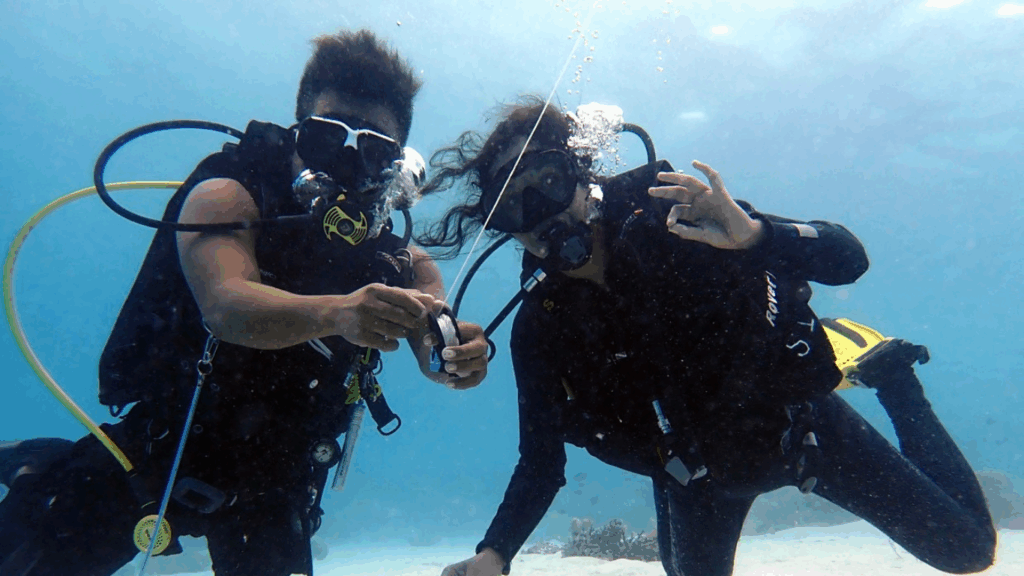
Diving and snorkeling in Derawan islands isn’t just about seeing marine life—it’s about starting your underwater journey in one of the most peaceful, vibrant, and beginner-friendly places in Indonesia. Whether you’re taking your first breath from a regulator or gliding over the reef with just a mask and snorkel, the Derawan Islands offer the kind of calm conditions and rich biodiversity that make every moment unforgettable.
Somewhere off the coast of Borneo, tucked inside the Coral Triangle, lies a small group of islands where the water glows blue, the turtles swim freely, and the reefs feel alive.
If you’ve ever dreamed of learning to dive or finally giving snorkeling a proper go, there may be no better place than here—the Derawan Islands. Remote, uncrowded, and full of marine life, this is one of Indonesia’s best-kept secrets.
This guide is for first-time snorkelers, Discover Scuba Diving (DSD) guests, and those looking to complete their Open Water or Advanced certification in a friendly, low-pressure environment.
The Derawan archipelago includes Derawan, Sangalaki, Kakaban, and Maratua—each with its own charm. Clear water, gentle currents, and a huge variety of marine life make diving and snorkeling in Derawan islands stress-free and inspiring. And because it’s remote, you’ll often have the water to yourself.
The dives here are shallow (often 5–18 meters), the visibility is excellent, and the reefs are full of gentle encounters with turtles, reef fish, and sometimes even manta rays. Many guests even see turtles from their water bungalow before stepping into the sea.
There are no crowds, no pressure, and no chaotic beach scenes. It’s just you, your guide, and a truly magical underwater world waiting to be explored.
Not quite ready to try diving? Snorkeling around the Derawan Islands offers a window into the same beauty—without the tank.
At Sangalaki, you might float just meters above a feeding manta ray. In Derawan’s shallow seagrass beds, you’ll likely spot green turtles gliding by. Off Maratua, healthy coral gardens attract reef fish, stingrays, and even the occasional leopard shark if you’re lucky.
And don’t worry if you’ve never snorkeled before. Our guides are used to beginners and will make sure your gear fits properly, you feel comfortable, and you know exactly how to move and breathe.
If you’ve never dived before but you’re curious, Discover Scuba Diving is your chance to try it without committing to a full course.
You’ll begin in calm, shallow water, close to shore, where you’ll learn how to breathe underwater and practice a few basic skills. Then—once you’re ready—you’ll follow your instructor into the reef, gliding among fish and corals in one of the safest environments in Indonesia.
Calm, shallow sites around are exactly why diving and snorkeling in Derawan islands is so beginner-friendly. Expect gentle currents, incredible visibility, and a surprising amount of marine life—even on your very first dive.
Many guests arrive here having snorkeled for years and finally decide to take the plunge—literally—by signing up for their PADI Open Water Course.
The course usually takes 3 days, and includes:
Already certified? The Advanced Open Water Course is a great way to explore deeper sites and build confidence. Plus, many dive spots like Meditation Wall, Gorgonzola, or Barracuda Point are perfect for gaining more experience while still enjoying a relaxed pace.
The answer? A little bit of everything – nothing guaranteed
When you’re not in the water, you’ll be relaxing at our resort on Derawan Island. Wake up to a view of the sea, enjoy breakfast with fellow divers, and finish the day with sunset beers and turtle sightings from the deck.
You can walk the whole island in 45 minutes, visit local shops and warungs, and even spot baby guitar sharks in the shallows after dark.
To make the most of diving and snorkeling in Derawan islands, here is a check list of what you can’t forget when visiting Scuba Junkie Sangalaki;
At Scuba Junkie Sangalaki, we specialize in introducing guests to the underwater world in a fun, safe, and supportive environment. Whether you’re dipping your face in the sea for the first time, or taking your first breath from a regulator—we’ll be with you every step of the way.
Already tried snorkeling but want to go deeper? Curious about your first manta ray encounter?
Leave us a comment—we’d love to help you plan your first underwater adventure 🐠

Derawan islands Kalimantan are the kind of place that still feels like a secret. Off the east coast of Borneo in Indonesia’s Coral Triangle, these 31 islands—most famously Derawan, Sangalaki, Kakaban, and Maratua—sit inside Berau Regency, East Kalimantan, surrounded by reefs so alive they hum with color. It’s remote, yes. But that’s part of the magic—and a big reason your visit has real impact.
The archipelago lies in the Sulawesi (Celebes) Sea, squarely in Indonesia’s East Kalimantan province (Borneo’s Indonesian side). Administratively they’re part of Berau Regency. Language? Indonesian, plus local Dayak, Kutai Malay, Buginese and more—Kalimantan is a mosaic.
Only Derawan and Maratua have resident communities (villages and small services). Kakaban and Sangalaki are uninhabited—think ranger posts and pristine nature rather than towns. That balance keeps the reefs wild and the nights wonderfully quiet.
Across the province, the majority of residents are Muslim (~87%), with Christian, Catholic, and other minorities adding to the cultural fabric. In coastal Berau, livelihoods historically lean on small‑scale fishing, with tourism increasingly important as a sustainable complement.
Pre‑COVID, more international routes made reaching East Kalimantan easier. Some have returned (for example, Kuala Lumpur–Balikpapan nonstop now operates with AirAsia and Malaysia Airlines on multiple weekly rotations), while others are still rebuilding. From Singapore, Scoot serves Balikpapan (BPN)—a helpful hub if you’re connecting to Berau (BEJ) or overland/sea to Derawan.
Most travelers still connect via Balikpapan → Berau, then continue by road and local boat—one reason a night in Balikpapan or Berau can be part of the adventure (and why planning ahead pays off). For Scuba Junkie Sangalaki’s on-the-ground transfer details, see the resort’s guide.
Tourism—done right—creates strong incentives to protect reefs and megafauna. NGOs and governments point out that manta rays are far more valuable alive to local economies than as products in trade. Responsible dive tourism helps fund monitoring, enforcement, and community jobs that replace extractive pressure.
Kakaban holds the world’s largest stingless jellyfish lake with multiple endemic species. Authorities have periodically closed access to the lake to support scientific research and protect the fragile, stratified ecosystem from stress (heat events, tourism pressure, and water‑quality concerns). Temporary closures let managers assess conditions and keep this phenomenon intact for the long term.
Good news: even when the lake is closed, Kakaban’s outer reefs deliver jaw‑dropping dives—walls, schooling life, and pelagic cameos. (Our Kakaban diving overview has trip specifics.)
Globally, reef (Mobula alfredi) and oceanic mantas (M. birostris) face pressure from fishing (meat and gill plate trade), bycatch, and slow reproduction. That combination lowers local encounter rates in some seasons and sites. Conservation groups (MMF, Manta Trust) and CITES listings highlight the trend and push for protection.
(Context for guests: mantas mature late and have one pup every few years—recoveries are slow even with protections. When we do see trains of mantas at Sangalaki, it’s extra special—and your respectful conduct and data sharing with researchers make a difference.)
From Scuba Junkie Sangalaki on Derawan, plan roughly:
What would you love to learn about Derawan islands Kalimantan next—local culture, manta science days with researchers, or a deep‑dive into our favorite wall sites? Drop your questions in the comments and help shape the next chapter.

Sangalaki diving offers adventurous divers the chance to explore a remote corner of Indonesia’s Coral Triangle, where manta rays, sharks, and turtles thrive in their natural habitat. With rich biodiversity and uncrowded sites, it’s no wonder this region is becoming a top destination for divers seeking authentic marine encounters.
Here are the top 5 marine life highlights you can experience when diving with Scuba Junkie Sangalaki.
If there’s one creature that defines Sangalaki diving, it’s the majestic manta ray. These gentle giants are seen year-round in the waters around Sangalaki, gracefully gliding over the reefs and often coming close to divers and snorkelers.
After your dives, you’ll enjoy surface intervals on beautiful beaches—chatting with fellow divers, sharing stories, and soaking in the tropical vibes.
Whale shark encounters are a highlight for many visiting the Derawan Archipelago. While not part of the Scuba Junkie dive trips, local fishermen offer snorkel excursions to see these gentle giants.
These tours are run by the local community, with trips offered year-round depending on weather and sea conditions. Sightings tend to be more likely around new moon periods, but there’s always a chance when you’re in the area.
Bookings can only be arranged once you’re on Derawan, as the location and conditions can change.
⚠️ Please remember: no touching, no flash photography, and maximum respect for these amazing animals.
Shark sightings are a thrilling part of the Sangalaki diving experience. You’ll often see white tip, grey reef and black tip sharks, cruising through the corals. And occasionally leopard sharks.
For the luckiest divers, there’s the chance to spot thresher sharks, and even hammerheads patrolling the deeper blue.
No matter where you dive, sharks remind us why we love the ocean—wild, untamed, and full of surprises.
For macro lovers, Derawan Island is where the magic happens. Here, you’ll find hairy octopus hiding in the sand, alien-like crabs nestled in coral crevices, and nudibranchs in every imaginable color and pattern.
Night dives at Derawan are particularly rewarding, revealing creatures that emerge only after dark, making every dive a treasure hunt.
One of the most unforgettable sights during Sangalaki diving is the sheer number of turtles. On almost every dive, you’ll encounter green turtles and hawksbill turtles gliding gracefully over the reefs or resting on coral bommies. It’s not uncommon to spot turtles right from your water bungalow balcony—a magical reminder of the underwater world that surrounds you.
For a special treat, join our staff for a sunset walk along the shores of Derawan. As the sky turns golden, you might spot baby guitar sharks swimming in the shallows—a rare and beautiful encounter you won’t soon forget.
At Scuba Junkie Sangalaki, we’re more than just a dive center. We’re a passionate team dedicated to sharing the beauty of Sangalaki diving while protecting the ocean we love.
🌴 Stay in our eco-friendly overwater bungalows
🤿 Dive daily with experienced PADI instructors
🌊 Explore the best of Sangalaki, Derawan, and beyond
Ready to dive into an unforgettable adventure? Check out our dive packages here
Sangalaki diving is a hidden gem of Indonesia’s underwater world. From soaring mantas and cruising sharks to the tiniest critters and baby guitar sharks at sunset, every moment is an opportunity for discovery.
What marine encounter are you most excited about? Let us know in the comments, or tag us in your underwater adventures @scubajunkiesangalaki!

Nestled in the heart of the Coral Triangle, Sangalaki is truly Indonesia’s best kept secret for divers. A paradise that promises thrilling underwater encounters, breathtaking biodiversity, and a sense of adventure at every dive site. If you’re looking for a dive destination that remains untouched by mass tourism while offering world-class marine life, look no further!
Sangalaki’s appeal lies in its rich marine biodiversity and unique dive sites that are unparalleled anywhere else in Indonesia. The island’s remote location in the Sangalaki Marine Park ensures minimal human impact, preserving its underwater treasures for those adventurous enough to visit.
Sangalaki is renowned for being one of the few places on the planet where you can dive with manta rays all year round. These graceful giants glide effortlessly through the shallow waters, feeding on plankton. Divers often find themselves surrounded by several mantas at once—an experience that feels almost surreal.

Sangalaki isn’t just about mantas. The region’s proximity to Whale Shark Point means divers can snorkel with these gentle giants during the right season. While sightings are not guaranteed, the thrill of swimming alongside a whale shark is unforgettable. Timing your visit around the new moon can increase your chances of an encounter.
Besides whale sharks, regular sightings of green and hawksbill turtles, plus colorful macro critters add to the excitement. Pulau Derawan’s reefs and sandy muck dive sites host a vibrant community of rare nudibranchs, cephalopods, and even the Lembeh Seadragon! Whether you are an underwater photographer or just an enthusiast, every dive is a discovery.
Sangalaki is not just about the excitement of potential manta ray sightings! Leopard sharks have been regularly spotted here and the stunning coral gardens are the host of a range of fascinating marine life, from giant moray eels to miniscule flatworms, as well as stunning schools of reef fish cruising the gentle sloping reefs and sandy channels.
Nearby, Kakaban Island offers more challenging dives with strong currents and deeper walls where pelagic species roam. Advanced divers can experience the thrill of diving with grey reef sharks, barracuda, and even the occasional visitor, such as thresher sharks, eagle rays and even the odd hammerhead!
With visibility reaching up to 40 meters, Maratua’s dive sites are a feast for the eyes. From vertical walls teeming with fish to sandy bottoms where rare critters lurk, the variety is astounding. Turtle fans will not be disappointed, as the aptly named Turtle Traffic can boast up to 100 turtles in a single dive, and don’t be surprised if a bumphead parrotfish or two crosses your way too.
What sets Sangalaki apart from other dive destinations is its unspoiled nature. Unlike more commercial dive spots, you’ll often have the entire site to yourself, allowing for a more intimate connection with marine life. Whether you’re drifting along the walls or exploring vibrant coral gardens, Sangalaki offers a sense of solitude that is increasingly rare in popular diving hotspots.
The Derawan Archipelago, which includes Sangalaki, Derawan, Maratua, and Kakaban, provides endless exploration opportunities. You can combine your diving adventure with visits to remote beaches, spotting baby guitar sharks, and stunning sunset spots.
The journey to Sangalaki is part of the adventure. The most common route is to fly to Berau or Tarakan and take a boat transfer to Derawan Island, where Scuba Junkie Sangalaki is based. Regular flights connect from Bali, Jakarta, and other major Indonesian hubs. From Derawan, daily dive trips to Sangalaki are easily arranged.
Scuba Junkie Sangalaki offers dive packages tailored for both beginner and advanced divers. As a PADI 5-Star resort, safety and professionalism are guaranteed, alongside the warm hospitality that makes every guest feel at home. Book your dive adventure today!
If you’re in search of Indonesia’s best kept secret for divers, Sangalaki should be at the top of your list. From manta rays to whale sharks, and pristine coral reefs to tranquil beaches, Sangalaki offers a diving experience that’s both thrilling and serene.
Ready to uncover this hidden gem? Send a message to Scuba Junkie Sangalaki to plan your trip!
Have you dived in Sangalaki before? We’d love to hear your stories! Share your favorite memories or photos in the comments or tag us on Instagram and Facebook with #ScubaJunkieSangalaki.